
IV Nutrient Therapy and NAD+: What to Know
A drip bag, a small catheter and thirty to sixty minutes deliver fluids, vitamins and, in one blend, NAD+ straight into your bloodstream. Here is what IV nutrient therapy is, where it came from, what the evidence honestly supports, and how it is offered in the wellness centre below the residence.
01What IV nutrient therapy is
Intravenous nutrient therapy delivers a mix of fluids, vitamins and minerals straight into a vein, by way of a small catheter and a drip bag, over roughly thirty minutes to an hour. Instead of swallowing a supplement and letting your digestive system decide how much of it to absorb, you receive the ingredients directly into your bloodstream, where they become available to your cells almost at once. At Amrit the drips are given in an IV lounge within the wellness centre below OASENA, and the menu runs from simple hydration to a recovery blend to a NAD+ infusion the resort calls a Longevity Drip.
It is worth being clear from the start about what this is and is not. A hospital gives fluids and nutrients intravenously to patients who are dehydrated, malnourished, or unable to eat — a genuine medical treatment for a genuine medical need. A wellness drip borrows the same equipment and much of the same science, but it is aimed at healthy people who feel run-down, jet-lagged, over-served the night before, or simply curious. That difference matters. It shapes what you can reasonably expect, and it is the reason a responsible IV lounge treats the whole thing seriously: a health questionnaire, a look at your veins, and clinical staff running the line.
The appeal is easy to understand. A drip feels decisive in a way a pill never quite does. You can watch it work its way down the tube, you feel the cool of the saline in your arm, and forty minutes later you walk out rehydrated. Whether the vitamins in the bag do much beyond the water is a more complicated question, and one this guide takes on directly rather than glossing over.
People reach for a drip for all sorts of reasons — a hard flight, a training block, a wedding weekend, a birthday that ran long, or a standing belief that a periodic top-up is good maintenance. Some come for the hydration alone and are entirely right to. Others come hoping the vitamins will do something more dramatic, and that is where expectations need managing. The service sits in a gray zone between medicine and spa, and the most useful thing a guide can do is tell you honestly which parts are which.
What tends to be in the bag
- A base fluid — usually sterile saline, which is the rehydration part and does most of the honest work.
- Vitamins — commonly vitamin C and the B group, sometimes others.
- Minerals — magnesium and calcium are typical additions.
- Sometimes amino acids or antioxidants — glutathione is a frequent add-on, and NAD+ in the longevity blend.
None of these ingredients is exotic. You meet most of them every day in food and a decent multivitamin. What changes in a drip is the route they take into you, and it is that route — the vein instead of the gut — that both the promise and the honest caveats of IV therapy hang on.
One more distinction is worth making clearly. A multivitamin, a good meal and a glass of water are the boring, proven ways most people meet their needs, and for a healthy person they do the job well. A drip does not beat them on nutrition; where it wins is speed and the promise that what goes in reaches the blood. Keep that narrow advantage in view and the service makes sense. Forget it, and you can end up paying a great deal for something a sandwich and a bottle of water would have handled just as capably.
02From the hospital ward to the Myers' cocktail
Delivering fluid and nutrition through a vein is old, hard-won medicine. Doctors experimented with intravenous infusions as far back as the seventeenth century, but it was the cholera epidemics of the 1830s, when patients died of dehydration faster than anyone could rescue them, that pushed physicians to inject saline solutions directly into the blood. Over the following century, sterile technique, safe fluids and reliable catheters turned the IV line into one of the most dependable tools in any hospital — the thing that keeps a dehydrated, feverish or post-surgical patient alive.
The wellness version of the story is much more recent, and it runs through one man. John Myers was a physician in Baltimore who, through the 1960s and 70s, treated patients with an intravenous blend of magnesium, calcium, several B vitamins and vitamin C. He kept no formal published protocol, but his regulars swore by it for fatigue, migraines, asthma and the general malaise of a hard week. After Myers died in 1984, another physician, Alan Gaby, took on many of those patients, refined the recipe, and wrote it up. He named it in Myers' memory. The Myers' cocktail is the direct ancestor of nearly every wellness drip offered today, including the ones you will find on a modern spa menu.
How a hospital tool became a spa service
Three things pulled the drip out of the clinic and into the lounge. The first was the rise of integrative and functional medicine, which took the Myers' cocktail seriously and folded it into private practice. The second was celebrity and word of mouth — performers using drips to recover between shows, and the frank, unglamorous truth that saline is an effective hangover remedy. The third was simple demand: a wellness culture increasingly willing to pay for anything that promises more energy, faster recovery and a hedge against aging.
By the 2010s, dedicated IV bars had opened in cities and resorts, mobile services would come to a hotel room, and the drip settled into the place it holds now — a wellness service offered alongside massage and the sauna, with clinical staff on hand. The menus grew as they went, adding antioxidants like glutathione, higher-dose vitamin C, and eventually NAD+ as the longevity conversation took off. Each addition arrived with bolder marketing than the evidence strictly justified, which is part of why a clear-eyed guide is useful.
When you settle into a chair for a drip today, then, you are at the far end of a line that runs from cholera wards to a Baltimore office to a quiet room above the Atlantic. The equipment is serious medicine. The way it is being used here is something lighter, and it helps to hold both facts in mind at once: real tools, modest wellness aims, and a history worth respecting.
It is a useful history to carry into the lounge, because it explains the two faces of the service. Everything technical about a drip — the sterile fluid, the catheter, the trained hands — comes from real medicine and deserves real respect. Everything aspirational about it — the promises of glow, immunity and long life — is a newer, softer layer, closer to the spa than the ward. Knowing which part you are buying is most of what it takes to use a drip well and spend on it sensibly.
03How it is thought to work: bypassing the gut
The whole case for IV over oral rests on one idea: bioavailability. When you swallow a vitamin, it has to survive stomach acid, get absorbed across the wall of the small intestine, and pass through the liver before any of it reaches the bloodstream. Your gut is a careful gatekeeper. For some nutrients it lets through only a fraction of what you take, and it caps how much it will absorb at once no matter how large the dose. Put the same nutrient into a vein and you skip every one of those steps. All of it reaches the blood, and it does so immediately.
That is not marketing; it is basic physiology, and it is exactly why hospitals use IV lines. The practical consequences are real:
- Higher blood levels. An intravenous dose can push the concentration of something like vitamin C far above what any pill could achieve, because the gut's absorption ceiling no longer applies.
- Speed. Rehydration and nutrients arrive in minutes rather than hours, which is the main reason a drip feels so immediate.
- A sure thing for absorption. If someone cannot absorb a nutrient by mouth — because of a gut condition, surgery or certain medications — the IV route sidesteps the problem entirely.
Where the logic gets slippery
Here is the catch that the sales pitch tends to skip. Higher blood levels are only useful if your body has a use for the extra. With many water-soluble vitamins — vitamin C and the B group especially — a healthy body simply filters the surplus out through the kidneys and passes it in urine. You end up, as the old line goes, with very expensive pee. The vitamin was delivered flawlessly; your body just had nowhere to put it.
Fat-soluble vitamins behave differently and can build up, which is one reason wellness drips lean on the water-soluble kind that the body clears easily — safer, but also the very ones a well-fed person is least likely to be short of. The exceptions are worth naming, because they are where the mechanism earns its keep. Magnesium given intravenously reaches useful levels quickly and has real, studied uses. Iron infusions are standard medicine for certain anemias when pills fail. Correcting a documented deficiency of any kind is exactly what the IV route is good at.
So the mechanism is genuine, but it only translates into a benefit under specific conditions: when you are short of the nutrient in question, when you cannot absorb it by mouth, or when the ingredient is the fluid itself. This is why the most reliable thing in almost any drip is the least glamorous. The saline rehydrates you dependably, and rehydration on its own can account for a good share of how much better people feel afterward.
A fair way to picture it: the fluid is the engine, and the vitamins are trim. When you are short of something, the trim matters and the IV route delivers it cleanly. When you are not, the engine still runs — you get the rehydration — and the trim mostly rides along and is passed out again. That is not a knock on the technology, which does exactly what it claims at the level of the bloodstream. It is simply a reminder that delivering a nutrient and needing it are two different things.

04What the evidence does and doesn't say
This is the part that deserves candor. IV nutrient therapy is popular, widely offered and, for healthy people, generally safe in trained hands — but the evidence that the vitamins do much for someone who is not deficient is thin. It helps to separate the claims that hold up from the ones that mostly do not.
What the evidence supports
- Rehydration is real. If you are dehydrated — after a long flight, a hard workout, a stomach bug or a heavy night — intravenous fluid works, and it works quickly. This is the one benefit that is not in dispute.
- Correcting a true deficiency helps. If a blood test shows you are low in a nutrient your body needs, replacing it matters. That is medicine, and IV can be the right tool when the gut is the problem.
- Some clinical uses are established. There is reasonable evidence for magnesium infusions in certain migraine and asthma situations, which is part of why the Myers' cocktail earned its early following.
What the evidence does not support
The bigger claims — that routine vitamin drips boost immunity, detoxify the body, slow aging or lift energy in already-healthy people — are not well backed. Studies on the Myers' cocktail itself are small and mixed; a well-known trial in people with fibromyalgia found the drip helped, but so did the placebo, and the two were hard to tell apart. Reviews of vitamin infusions for general wellness tend to reach the same modest verdict: not harmful in healthy people, but no convincing proof of benefit beyond hydration and any placebo effect.
The detox claim deserves a special mention because it comes up so often. Your body already has two excellent detox organs — the liver and the kidneys — that work around the clock. A bag of vitamins does not do their job for them, and there is no good evidence that an infusion clears toxins in any meaningful sense. The word is doing marketing work, not medical work.
The reasonable position is a plain one. Treat an IV drip as a fast, pleasant way to rehydrate and, occasionally, to top up a nutrient you are short of — not as a treatment for any disease and not as a shortcut to health you could not get from sleep, water and food. If you feel chronically exhausted, that is a reason to see a doctor and find out why, not a reason to keep buying drips. Genuine fatigue can point to anemia, thyroid trouble, sleep disorders and much else that an infusion will only mask.
A last word on immunity, since it is the season's favorite claim. High-dose vitamin C and other add-ons are often sold as a way to fend off a cold or shake one faster. The evidence for that in well-nourished people is weak, and a single infusion is not going to armor your immune system for a trip. If you want to travel healthy, the dull advice still wins: sleep, hand-washing, sensible eating and staying hydrated. A drip can be part of the hydration, but it is not a shield, and it should not be sold to you as one.
A drip feels decisive in a way a pill never quite does — but the honest work in most bags is done by the water, not the vitamins.
On the IV lounge at Amrit
05NAD+ and the Longevity Drip
The NAD+ infusion is the drip people ask about most, so it is worth its own section — and its own dose of realism. NAD+, or nicotinamide adenine dinucleotide, is a coenzyme found in every living cell. It is central to how your cells turn food into energy and to a family of repair and signaling processes. NAD+ levels are known to fall with age, and that single fact is the seed of an enormous amount of interest, investment and hope in the longevity world. The idea is intuitive: if the molecule declines as we age, perhaps restoring it could slow some of what aging does.
Amrit offers a NAD+ infusion it calls the Longevity Drip. What you should know before you consider it is that the science is early and mostly unproven in humans.
What is known
- The biology is real and interesting. NAD+ matters enormously inside cells, and much of the promising work — on metabolism, on aspects of aging in the lab — is legitimate research, not fantasy.
- Most of the striking results are in animals or cells, not in long-term human trials. Whether raising NAD+ in a person extends healthy years is, at this point, an open question rather than an established fact.
- Delivery is unsettled. It is not even fully clear how much of an intravenous dose reaches the inside of cells as usable NAD+, versus being broken down along the way. Oral precursors like NR and NMN raise blood NAD+ markers, but the health payoff is still being studied.
What a NAD+ drip feels like
There is one very practical thing to know: NAD+ infusions can be uncomfortable if run too fast. People commonly report a flushing sensation, chest or stomach tightness, nausea or a racing feeling — which is precisely why they are given slowly, over a longer period than a standard drip, and why clinical supervision matters. Slowing the drip usually settles the sensation, and a good practitioner will pace it to your comfort rather than the clock.
It is also worth setting the money-and-time expectation clearly. A NAD+ infusion is among the longer and more involved things on any drip menu, and the marketing around it tends to promise sharper focus, more energy and a slowing of aging that the current evidence simply cannot promise. Some people report feeling clearer or more energetic afterward; those reports are real, but they are not the same as proof that the molecule is doing what the brochure says.
None of this is a reason to write NAD+ off. It is a reason to approach it with clear eyes: as an early, promising, still-unproven area of longevity science, not a validated anti-aging treatment. If the idea interests you and you have no contraindications, it can be a fascinating thing to try in a supervised setting. Just hold the marketing language lightly, and do not spend on it expecting a promise that the research cannot yet give.
If you do try it, a couple of practical notes help. Give yourself an unhurried block of time, since the slow infusion is the whole point and rushing it is what causes discomfort. Eat beforehand rather than arriving on an empty stomach. And treat any single session as an experiment of one: notice how you feel over the following day or two, honestly, without deciding in advance that it must have worked. That kind of plain self-observation is worth more than any claim on a menu.
06What a session is like
The experience is calmer and more clinical than people expect, and that is a good sign. A drip that is being done properly begins with paperwork, not a needle.
Before the line goes in
You fill out a health history — conditions, medications, allergies, whether you might be pregnant. A member of the clinical staff reviews it and talks through which blend suits you and whether any ingredient should be left out. This screening step is the difference between a wellness service and a gimmick; a lounge that skips it is one to be wary of. Some infusions, NAD+ among them, warrant extra questions before anyone agrees to run them. It is entirely reasonable to ask what is in the bag, who is placing the line, and what happens if you feel unwell partway through.
During the drip
You settle into a reclining chair. The staff member cleans a spot, usually in the crook of your arm or the back of your hand, and places a small catheter — a brief pinch, then nothing. The bag hangs above you and the fluid runs in under gravity or a pump. Most standard drips take about thirty minutes to an hour; NAD+ runs longer and slower on purpose. You may feel:
- Coolness traveling up your arm as room-temperature fluid enters a warm body.
- A vitamin taste at the back of your throat — oddly common with the B vitamins and magnesium, and harmless.
- Warmth or a flush, especially with magnesium or NAD+, which usually eases if the drip is slowed.
- A little bruising at the site afterward, the same as any blood draw, which fades in a day or two.
Otherwise there is little to do but sit. People read, scroll, close their eyes, or chat quietly with whoever came along. You can usually stop at any time if something feels off, and good staff will check on you throughout rather than starting the line and disappearing.
Afterward
The catheter comes out, you get a small bandage, and that is it — no downtime, no recovery. The rehydration you often notice right away; any subtler effects are, honestly, harder to pin on the vitamins versus the fluid and the rest. Drink water for the remainder of the day, eat something normal, keep the bandage on for a little while, and do not book a drip as a substitute for the sleep your body is asking for. If anything feels wrong in the hours after — a spreading redness at the site, a rash, breathing trouble — treat it as you would any medical concern and get help.
A small point that surprises people: the vein, not the vitamins, is usually the only part that asks anything of you. If you dislike needles, say so — staff can numb the site, use a smaller catheter, and talk you through it, and the placement is over in seconds. Hydrating well the day before makes your veins easier to find, which makes the whole thing quicker and more comfortable. Once the line is in, the session is restful, and most people are surprised how quietly the time passes.

07What people report — and how to read it
Talk to enough people who use IV drips and you hear a consistent set of reports. They are worth taking seriously as experiences, while staying honest about what is probably driving them.
- Feeling rehydrated and clearer-headed, especially after travel, exercise or alcohol. This one is the most believable, because the fluid does it.
- A lift in energy for a day or two. Real for some people, though hard to separate from hydration, rest, and the simple act of sitting still for an hour.
- Faster recovery from a hard workout or a big night. Plausible on the hydration front; less certain that the vitamins add much on top.
- Fewer or milder hangover symptoms. Largely the saline at work — a hangover is partly dehydration — which is why this is one of the drip's most reliable uses.
- A general sense of having done something good for themselves, which is not nothing on a wellness stay, but is also where the placebo effect lives.
Why the placebo point is not a dismissal
It is tempting to hear "placebo" and assume that means fake. It does not. A calm hour in a comfortable chair, cool fluid rebalancing you, staff paying attention to how you feel — these produce a real, felt improvement, and the fluid on its own has a genuine physiological effect. The honest framing is simply about attribution: much of the benefit comes from rehydration and rest rather than from any exotic ingredient, so you should not pay a premium expecting the vitamins to be doing the heavy lifting.
There is also a quieter benefit that gets underrated: the pause itself. Very few of us sit still and do nothing for forty-five minutes on purpose. On a busy trip, the enforced stillness of a drip — no chores, no walking, nothing to organize — is its own small reset, closer to the value of a nap or a long float than to anything in the bag. That is a real thing to enjoy, as long as you are honest with yourself about where it is coming from.
Set your expectations accordingly and you are unlikely to be disappointed. Come in dehydrated and tired, leave rehydrated and rested, and enjoy the pleasant ritual of it. Treat it as a top-up and a comfort, not as a cure or a transformation, and it earns its modest place on a wellness itinerary. Chase it as a miracle and it will always fall short, because that was never what it was.
There is one group for whom the honest math tilts more favorable: people arriving depleted. After a red-eye, a hard event or a bout of something that left you dehydrated, the fluid meets a real need, and the lift is correspondingly clearer. The further you are from that state — well-rested, well-fed, already hydrated — the smaller the honest return, until at some point you are paying mostly for the chair and the calm. Neither is wrong to want. It just helps to know which one you are buying on a given day.
08Who it suits — and who must ask a doctor first
A drip is not for everyone, and the reasons are worth spelling out clearly, because putting fluid and concentrated nutrients directly into the bloodstream is a bigger intervention than swallowing a pill. This is exactly why it should be done by clinical staff who screen you first.
It tends to suit
- Healthy adults who arrive dehydrated — after a long flight, a hard training day or a late night — and want to rebalance quickly.
- People who have trouble absorbing a nutrient by mouth for a known reason, in which case a doctor may recommend the IV route.
- Anyone curious about a supervised wellness ritual, provided they hold realistic expectations about what the vitamins can do.
Ask your doctor before you book if any of these apply
- Kidney disease. Your kidneys manage your body's fluid, sodium, potassium and mineral balance. A load of fluid and minerals that is harmless for most people can be dangerous if your kidneys are impaired. This is the single most important caution.
- Heart failure or serious heart conditions. A rapid infusion of fluid increases the volume your heart must move, which can be risky for a struggling heart.
- Pregnancy or breastfeeding. Many drip ingredients have not been studied for safety in pregnancy; ask your own clinician rather than a spa.
- Allergies, or a history of reactions to any infusion or additive. Reactions are uncommon but possible, and staff need to know.
- High blood pressure, or a fluid-sensitive condition. Extra fluid volume can affect blood pressure.
- G6PD deficiency. High-dose intravenous vitamin C can be harmful for people with this inherited condition, which is one reason a health history is taken.
- Any chronic illness or regular medication. When in doubt, bring your list and ask first.
It is also worth knowing the small risks that come with any needle in a vein, even in careful hands: a bruise or a little soreness at the site, occasional inflammation of the vein, and, rarely, infection or a reaction to an ingredient. These are usually minor and the reason the staff watch you, but they are the honest price of the route and part of why walk-in speed is not the point.
One line matters more than any other on this page: an IV drip is not a diagnosis and not a treatment for disease. If you feel persistently exhausted, foggy or unwell, the right move is to see a doctor and find the cause — not to keep topping up with infusions that may be papering over something that deserves real attention.
None of this is meant to frighten anyone off a service that is, for healthy screened adults, generally low-risk. It is meant to draw the line where it belongs. The people who do best with drips are the ones who treat them as the mild wellness service they are: they answer the health questions honestly, mention every medication and condition, and let a professional say no when no is the right answer. A lounge that is willing to turn you away when it should is exactly the kind you want running a line into your arm.
09The IV lounge below the residence
What sets the drip here apart is less the menu than the setting and the staffing. The infusions are given within the wellness centre a short elevator ride below OASENA — a roughly 100,000-square-foot facility with a full slate of regenerative therapies, of which IV is one. They are administered by clinical staff, in a proper lounge, with the health screening that this kind of service should always carry. That last point is not a small thing: the same drip is a very different proposition given by trained staff after a proper questionnaire than it is bought on a whim with no questions asked.
The drip menu, in plain terms
- Hydration — essentially fluids, the most honest and reliably useful thing on offer, and a sensible choice after a flight or a beach day.
- Recovery — a blend aimed at bouncing back from exertion or a heavy evening, with the caveat that the saline is doing much of the work.
- The NAD+ Longevity Drip — the longevity-minded infusion covered above, run slowly and worth approaching with realistic expectations.
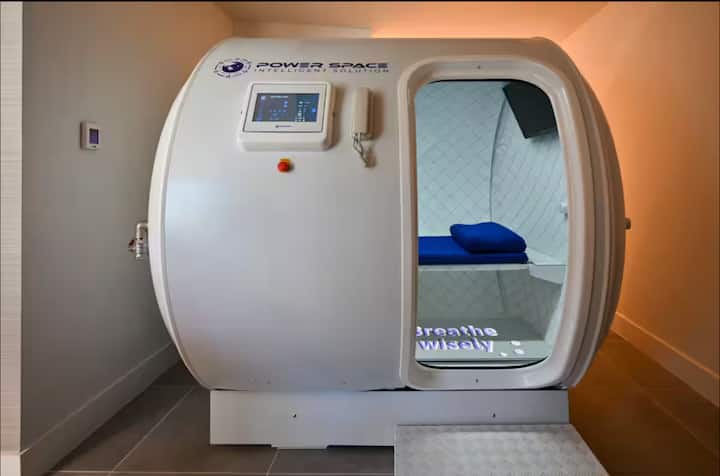
Because IV therapy sits within a larger wellness world here, it makes most sense as one thread among several rather than the centerpiece. The same suite holds hyperbaric oxygen therapy, red light, the Ammortal Chamber and more; downstairs from those is the Aayush hydrothermal circuit with its plunge pools, sauna and salt chamber. A drip can be a quiet bookend to a fuller morning of wellness, or a standalone forty minutes when you simply want to rehydrate and reset. If you are already planning massage and a soak, ask the staff whether a drip belongs in the sequence at all for you, or whether water and a good lunch would do the same job.
Access for residence guests
Guests of the residence reach the wellness centre at preferred rates, and access is subject to the resort's terms and to the screening the staff carry out. Booking ahead is wise, since infusions require a staff member's time and a review of your history — not a walk-up you squeeze in on the way to the beach. A short conversation when you arrive, or a note before your stay, lets the team tell you which blend fits and whether anything on the menu is one to skip given your health. OASENA is privately owned and is not operated by or affiliated with the resort; the spa is a neighbor you are fortunate to have an elevator ride away, not an amenity the residence runs.
The practical beauty of it is the same as everything else in this building: you do not need a car, a drive or a plan. You come down, you sit, you rehydrate, and you go back up to the twelfth floor and the Atlantic.
Because the spa is a neighbor rather than something the residence controls, the specifics — exactly which blends are on the menu on a given week, timing, and terms — are set by the resort and worth confirming when you book. The residence's part is simpler and more pleasant: it puts you an elevator ride from all of it, so a drip is a decision you can make on the morning rather than a trip you have to plan. That proximity, more than any ingredient, is the real luxury of having the wellness centre downstairs.
10Folding a drip into a Singer Island day
An IV drip works best not as a headline but as a small, well-placed comfort inside a good day. A few ways it tends to fit the rhythm of a Singer Island stay:
The arrival reset
Travel is quietly dehydrating — the dry cabin air, the long day of doors and terminals, maybe a drink or two on the way. A hydration drip on your first morning is one of the more defensible uses of the service. Come down, rehydrate, and start the week feeling like yourself rather than spending the first day catching up. Then go up, open the balcony doors, and let the sea air do the rest.
The recovery morning
Say you dove Blue Heron Bridge on the slack tide, walked the estuary boardwalk at MacArthur Beach, or had a long, late dinner over the water at the Sailfish Marina. A slow morning with a recovery drip — paired with the sauna and a cold plunge in the Aayush circuit — is a pleasant way to reset before doing it all again. Bracket it with water and a real breakfast and you will feel the difference.
The wellness half-day
If you are the kind of traveler who came in part for the spa, a drip slots naturally into a longer session downstairs. Move through the hydrothermal circuit, add red light or hyperbaric oxygen if that is your interest, and let a hydration or recovery drip be the calm, seated middle of it. On a longevity-minded stay, the NAD+ infusion belongs here too — approached, as always, with clear eyes about what it can and cannot promise.
When to skip it
It is just as useful to know when not to bother. If you have been sleeping well, drinking water and eating properly, a drip has very little to add, and there is no honest reason to book one out of a sense that more is better. Save it for the moments it fits — the depleted arrival, the morning after the long night — and it stays a treat rather than a habit. That restraint is, quietly, the most expert way to use the service.
A short honesty note to end on
The single best thing you can do for your energy on a trip is not in a bag. It is a decent night's sleep, water within reach through the day, real food, sun in the morning and a swim in a warm ocean — all of which the residence and this stretch of coast hand you for free. A drip is a nice, occasional accent on top of that foundation, not a replacement for it. Use it that way — as rehydration and ritual rather than rescue — and it takes its rightful place: a small, civilized comfort an elevator ride below your door.
Read all of this as an invitation rather than a warning. A drip is a fine thing to try once on a long, restorative stay, and there is real pleasure in the ritual of it done well — the cool of the line, the quiet chair, the ocean waiting upstairs. Keep your expectations honest and your questions ready, let the clinical staff guide you, and it becomes exactly what it should be: one small, well-run comfort among the many this stretch of coast already hands you for nothing at all.
Common questions
Do the vitamins in an IV drip do anything, or is it mostly the fluid?
For a healthy, well-nourished person, much of the felt benefit comes from the <strong>rehydration and the rest</strong>, not the vitamins — a body that is not short of a nutrient simply filters out the surplus. The vitamins help only if you are deficient or cannot absorb them by mouth. Rehydration, by contrast, is real and reliable. Think of a drip as a fast, pleasant way to rehydrate and occasionally top up, not as a treatment.
Is a NAD+ Longevity Drip proven to slow aging?
No. NAD+ is a real and important molecule that declines with age, and the research is interesting, but most striking results are in animals or cells rather than long-term human trials. Whether an infusion extends healthy years in people is still an open question. It can be a fascinating thing to try in a supervised setting — just hold the anti-aging language lightly.
Who should not get an IV drip?
Ask a doctor first if you have <strong>kidney disease, heart failure or a serious heart condition, high blood pressure, allergies to infusions or additives, G6PD deficiency, or any chronic illness</strong>, and if you are <strong>pregnant or breastfeeding</strong>. Kidney and heart conditions are the most important cautions, because your body has to handle the added fluid and minerals. A drip is never a substitute for a proper diagnosis.
Is it safe, and who gives it?
At Amrit the infusions are administered by <strong>clinical staff</strong> in an IV lounge within the wellness centre, and they should always begin with a health questionnaire and a review of your medications and allergies. For healthy people who are screened first, drips are generally well tolerated. NAD+ is run slowly on purpose, since going too fast can cause flushing or a tight, uneasy feeling that settles when the drip is slowed.
A note on wellness & health
This guide is general information about therapies offered at the resort spa, not medical advice, diagnosis or treatment. Wellness services are elective and results vary from person to person. Talk with a qualified healthcare professional before starting any new therapy, especially if you are pregnant or managing a medical condition. OASENA is privately owned and is not operated by, affiliated with, or endorsed by Amrit Ocean Resort & Residences. Spa access is offered to residence guests at preferred rates, subject to the resort’s terms and availability.



Your quiet address above the Atlantic
OASENA is a private two-bedroom home on the twelfth floor of the Happiness Tower — floor-to-ceiling ocean views, a sweeping balcony, and this entire wellness world an elevator ride below.
OASENA is a privately owned residence within Amrit Ocean Resort & Residences and is not operated by, affiliated with, or endorsed by the resort. See credits & notes.