
Craniosacral Therapy and Myofascial Release Explained
Two of the gentlest treatments on the spa menu, offered in the treatment rooms below the residence. Here is what craniosacral therapy and myofascial release are, where they came from, what the science does and doesn't support, and how a session really feels.
01What these two therapies are
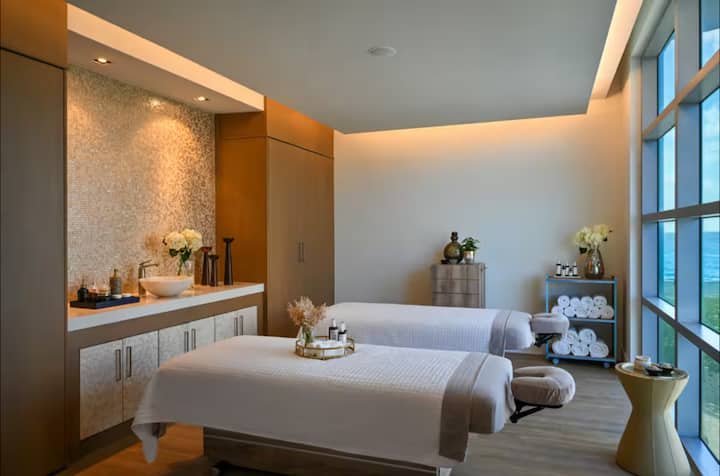
Craniosacral therapy and myofascial release are two of the quietest treatments on the spa menu below the residence. Both are hands-on, both are slow, and both ask almost nothing of you beyond lying still on a padded table while a practitioner works. Neither involves the brisk kneading most people picture when they hear the word massage. Craniosacral therapy, usually shortened to CST, uses a touch so light it is often compared to the weight of a small coin. Myofascial release works a little more firmly, with slow, sustained pressure that follows the body’s connective tissue rather than fighting it. Both are offered by appointment in Amrit’s treatment rooms, a short elevator ride below OASENA.
It helps to say clearly what they are not. Neither is a medical treatment. Neither is a chiropractic adjustment, with its quick thrusts and audible clicks. And neither is the deep, sometimes uncomfortable pressure of a sports rubdown. These are gentle therapies. The practitioner moves slowly, holds positions for a long time, and waits for the body to respond rather than forcing it. If you have ever found ordinary massage too vigorous, or you simply want an hour of unhurried quiet, this is the softer end of the bodywork world, and it rewards a slower kind of attention than most spa treatments ask for.
The two are often mentioned in the same breath because they share a family tree and a temperament, but they are distinct. It is worth setting them side by side before we go any further, because knowing which is which lets you ask for the one you want.
The short version of each
- Craniosacral therapy centers on the head, the spine and the sacrum, the triangular bone at the base of the back. The practitioner rests their hands very lightly on these areas and tunes in to what they describe as a subtle rhythm in the tissues, then encourages it to ease and settle. The touch is feather-light from start to finish, and much of the session can feel as if barely anything is happening.
- Myofascial release works the fascia, the continuous sheet of connective tissue that wraps every muscle, bone and organ like a second skin. The practitioner uses slow, gliding pressure and gentle sustained stretches to coax areas that feel tight or bound. It is firmer than CST but still slow and patient, nothing like a deep-tissue grind, and it is aimed more at movement and tightness than at pure relaxation.
You can book either one on its own, and many people do. You will also find that a skilled therapist blends elements of both within a single hour, reading your body and choosing the lighter or firmer approach as they go. What unites them is the pace. Everything happens slowly, nothing is rushed, and the whole point is to let a busy nervous system drop into a lower gear. If you arrive expecting a brisk, energetic massage, the calibration will feel unfamiliar at first, which is exactly why it helps to know what you are signing up for.
02Where they came from
Both therapies grew out of osteopathy, a branch of manual medicine founded in the American Midwest in the late nineteenth century by a physician named Andrew Taylor Still. Still had lost faith in much of the medicine of his day and built an approach around a simple conviction: that the body’s structure and its function are bound together, and that skilled hands can help the body correct itself. From that root, two distinct lineages branch off, one leading to craniosacral therapy and the other to myofascial release. Understanding the split explains a great deal about why one is more controversial than the other today.
The craniosacral line
In the early twentieth century, an osteopath named William Garner Sutherland became fascinated by the bones of the skull. The prevailing view was that adult skull bones are fused solid, but Sutherland became convinced they retained a tiny amount of movement, and that a slow, rhythmic motion could be felt in the head and passed down the spine to the sacrum. He called this idea the primary respiratory mechanism and spent decades developing what became known as cranial osteopathy, teaching a small circle of practitioners to feel for it with their hands.
Decades later, in the 1970s, an osteopathic physician named John Upledger took these ideas, softened and simplified them, and taught them widely to practitioners who were not osteopaths. Working at a university, he coined the term craniosacral therapy and built a training system around it that reached massage therapists and bodyworkers across the world. That is why CST today is offered in spas by therapists rather than only by physicians, and it is also why it drifted away from the medical mainstream that produced it.
The myofascial line
Myofascial release owes its modern popularity to two figures in particular. In the mid-twentieth century, a biochemist named Ida Rolf developed a system she called Structural Integration, later known as Rolfing, built on the conviction that the body’s fascia could be reshaped through firm, deliberate manipulation, improving posture and ease of movement. Around the same time and afterward, physical therapists refined gentler fascial techniques for clinical use, and the physical therapist John Barnes became closely associated with teaching a slow, sustained style of myofascial release to a broad audience of clinicians and bodyworkers.
So when you lie down for either treatment today, you are at the end of a long line that runs from a nineteenth-century frontier doctor through a skull-obsessed osteopath and a fascia-obsessed biochemist to a calm, dim room above the Atlantic. The lineage matters because it explains both the appeal and the controversy. These are old, intuitive, hands-on ideas, some of which modern science has since supported and some of which it has not. Neither therapy fell from the sky as a spa gimmick; both came out of a serious, century-old effort to treat the body with the hands. Keeping that history in view makes it easier to enjoy what is good about them without swallowing every claim whole.
03How they are thought to work
The proposed mechanisms are worth understanding, because they are also where the two therapies part company with mainstream science in interesting ways. It is possible to enjoy either treatment without believing every claim made for it, and being clear about the ideas helps you do exactly that. The two rest on very different footing, so take them one at a time.
The craniosacral idea
Craniosacral therapy rests on the belief that the fluid surrounding the brain and spinal cord, the cerebrospinal fluid, moves in a slow, tide-like rhythm, and that this rhythm can be felt by trained hands at the skull and sacrum. Practitioners describe sensing restrictions in that rhythm and gently releasing them, with the aim of calming the nervous system and easing tension carried in the tissues. The touch is kept extremely light, on the theory that the body responds better to a soft invitation than to force, and that heavy pressure would only make a guarded system brace harder.
Here is the honest complication. There is little reliable evidence that adult skull bones move in the way the theory requires, and studies have repeatedly found that different practitioners feeling the same person often do not agree on what the rhythm is doing. That does not mean nothing is happening under those hands, but it does mean the specific mechanical story is on shaky ground. A more grounded explanation is that very light, sustained, attentive touch calms the nervous system in its own right, slowing the breath and heart and easing the body out of its fight-or-flight setting. That is a real and well-documented effect, and it may be most of what a good CST session delivers.
The myofascial idea
Myofascial release stands on firmer ground, though not perfectly firm. Fascia is unquestionably real: a continuous, sensitive web of connective tissue that can thicken, stiffen and tug on the structures around it. The theory is that slow, sustained pressure and stretch encourage tight or restricted fascia to soften and lengthen, easing pain and restoring movement.
- The pressure is patient. Rather than a quick rub, the therapist leans slowly into an area and holds, sometimes for minutes, letting the tissue give way on its own timeline instead of being forced.
- The nervous system is part of it. Some of the loosening people feel is almost certainly the muscle and its nerves relaxing, not just the fascia physically stretching, which is why a calm mind makes the work go better.
- Whole-body thinking. Because fascia is continuous, a therapist may work a spot far from where you feel tight, on the theory that a pull in one place shows up in another further along the chain.
Taken together, both therapies likely share a common engine: slow, safe, focused touch that signals to a guarded nervous system that it can stand down. Whatever else is or is not happening in the tissue, that alone is a legitimate reason many people leave feeling markedly calmer and looser than when they arrived.
04What the evidence does and doesn't say
This is the section that matters most, and the one where it is easiest to be misled by enthusiastic marketing. The two therapies sit at different points on the evidence scale, so it is worth taking them one at a time and being candid about both. Neither has the strong medical backing that a proven treatment carries, but they are not equal, and it would be dishonest to pretend otherwise.
Craniosacral therapy: weak and contested
For craniosacral therapy, the scientific support for its specific claims is thin. Systematic reviews have generally concluded that the studies are few, small and of low quality, and that there is not good evidence CST reliably treats any particular medical condition. The core premise, that trained hands can feel and correct a cranial rhythm, has fared badly in reliability testing, with practitioners frequently disagreeing about what they feel in the same person. This is the plain state of the research, and any honest guide has to say so rather than dress it up.
And yet a great many people find a craniosacral session deeply relaxing, and that experience is real and worth having. The most reasonable reading of the evidence is that CST works largely through the well-known power of calm, attentive touch and a quiet, unhurried hour, rather than through the mechanism its founders proposed. That makes it a lovely way to unwind and quiet a busy mind. It does not make it a treatment for any disease, and you should be wary of anyone who tells you it cures serious conditions.
Myofascial release: modest but real support
Myofascial release does better in the literature, though the picture is mixed. There is modest evidence that it can help with some kinds of pain and stiffness, including certain cases of chronic back and neck pain and reduced mobility, and it is used within physical-therapy practice for exactly these reasons. The studies are often small, and they frequently combine myofascial work with other treatments such as exercise, so the size of the specific benefit is hard to pin down. Still, the direction is more encouraging than for CST, and the underlying idea, that connective tissue matters to how we move and feel, is uncontroversial. A handful of trials point to gains in flexibility and short-term relief from pain, particularly when the hands-on work is paired with movement and stretching between sessions, though nobody should expect a single hour to undo a problem that took years to build.
The sensible position for both is the same modest one. Treat them as relaxing, well-tolerated wellness practices that some people find helpful for tension and comfort, not as proven medical therapies. If you live with a real medical problem, use these as a pleasant complement to, never a replacement for, the care your doctor provides. If a session ever causes sharp pain rather than a slow easing, say so and have the therapist adjust or stop. Held to realistic expectations, both can be a real pleasure. Sold as cures, they are neither honest nor safe.
The practitioner barely seems to move. For long stretches nothing happens at all, and then, quietly, your shoulders drop half an inch and stay there.
On a craniosacral session at Amrit
05What a craniosacral session is like
There is almost nothing to do, which is the whole point. You stay fully clothed, in something comfortable, and lie on your back on a padded table. The lights are low. The room is quiet, sometimes with soft music, sometimes with nothing at all. A session usually runs somewhere between an hour and seventy-five minutes, and for much of it you may feel as if very little is happening on the surface, even as your body slowly settles underneath.
The therapist begins by resting their hands lightly on your feet, your hips, your ribs, your shoulders, and finally the base of your skull, moving unhurriedly from one contact to the next. The pressure is astonishingly gentle, often no more than the weight of a hand simply resting there, nothing that presses or grips. They will pause and hold each position for a long time, sometimes several minutes, tuning in to what they feel and waiting. There is no set choreography you need to follow and no feedback you need to give unless something feels wrong. Many people find the not-knowing-what-is-happening part strange for the first few minutes and then stop caring, because the room is warm, the hands are steady, and there is nothing you are supposed to do. If it helps, think of it less as a treatment being done to you and more as an hour of enforced rest with a calm person in the room.
What you might notice
- Deep stillness. Most people describe sinking into a drowsy, half-asleep calm, the kind you feel just before you drop off at night. Some fall fully asleep, which is completely fine and often a sign it is working for you.
- Warmth and small releases. You may feel spreading warmth under the therapist’s hands, a limb growing heavy, a gut gurgle, or your breathing slowing and deepening without any effort on your part.
- Very little drama. There is no cracking, no deep pressure, no working-through-the-knots discomfort. If you are expecting a vigorous massage, this will feel almost unnervingly subtle for the first ten minutes.
People react differently, and it is worth knowing that in advance so nothing surprises you. Many float out feeling loose and unusually calm, as if the volume on the day has been turned down. A few feel a little spacey, tearful or emotional for a short while afterward, which practitioners consider unremarkable and which passes on its own. And a certain kind of person simply finds the whole thing too quiet and understated to enjoy, and would rather have a firm, conventional massage that they can feel working. None of these responses is wrong. Craniosacral therapy is a particular taste, and the surest way to learn yours is to try one session with modest, open expectations. Bring water, plan to move slowly afterward rather than rushing into a busy afternoon, and let the calm carry over into the rest of your day instead of spending it in a hurry.
One practical tip: go in without a checklist. Craniosacral therapy is not a session where you can direct the therapist to a sore spot and expect them to work it the way you would in a deep massage. The whole approach is to let the body lead and to follow it patiently, so the more you can set aside the urge to make something happen, the more you tend to get out of it.
06What a myofascial release session is like
Myofascial release feels different from craniosacral work, and if you have had a conventional massage it will feel more familiar, though still slower and more deliberate. Depending on the therapist and the areas being worked, you may be draped like a massage client or stay in loose, comfortable clothing. The therapist often uses little or no oil, because part of the technique relies on a gentle drag against the skin rather than a slippery glide, so the hands can find and hold the tissue rather than sliding over it.
The pace is what stands out most. Instead of the rhythmic strokes of a Swedish massage, the therapist finds an area that feels tight or restricted and leans into it slowly, then simply holds, waiting for the tissue to soften under steady pressure. A single hold can last a minute or more, which feels like a long time until you get used to it. It should feel like a strong, warm stretch, sometimes right at the edge of intensity, but never a sharp, hot or bruising pain. The good version lives in that comfortable-but-firm zone where you can still breathe and stay relaxed. You may also hear or feel small shifts as an area lets go, and the sensation of a tight spot slowly yielding under a patient hand is, for a lot of people, oddly satisfying in a way a fast massage never quite manages.
How to get the most from it
- Speak up about pressure. The right amount is firm enough to feel a stretch but gentle enough that you can breathe easily and stay loose. Tell the therapist if it tips into real pain, and they will ease off without any fuss.
- Breathe into the holds. Slow, full breathing helps the tissue and the muscle let go. Many therapists will cue you to exhale as they sink in, and it makes a difference.
- Expect work away from the sore spot. Because fascia is continuous, relief for a tight shoulder might come from work on the arm, the ribs or the hip. This is normal and not the therapist losing the plot.
- Give feedback as you go. Unlike CST, this is a treatment where your running commentary helps, so mention what feels tight, what feels better, and where you want more time.
Afterward, people commonly report feeling looser, taller and more mobile, as if a band of stiffness has drained away and a joint moves more freely than it did an hour ago. It is also common to feel mildly tender the next day, much as you might after a good stretch or a workout, and to feel thirstier than usual. Drinking water, moving gently, and giving the area a day before anything strenuous all help the good feeling last. As with craniosacral therapy, the honest promise is comfort and ease rather than cure, and it delivers that comfort reliably enough that many people fold it into a longer wellness day without a second thought.
07The benefits people report
It is worth separating what people consistently report from what is sometimes over-promised. Held to the modest, relaxation-first framing these therapies deserve, the benefits are real and worth having, even if they are not miracles and even if they rarely last forever. What follows is the honest, everyday version of what a good session tends to deliver, drawn from what people who go regularly say rather than from a brochure.
What comes up again and again
- Deep relaxation. This is the headline for both, and especially for craniosacral therapy. People describe a rare, complete quieting of a busy mind, of the sort that is hard to reach on your own, and that a vacation is supposed to be for.
- Relief from everyday tension. The stiff neck and locked shoulders that travel, screens and stress leave behind often ease noticeably, at least for a while, which on a trip can be enough to change how the rest of the day feels.
- A feeling of loosening and space. Myofascial work in particular can leave you moving more freely, standing a little taller, and turning your head or reaching overhead with less catch than before.
- Better sleep afterward. Many people report that the calm carries into a deep night’s sleep, which on a holiday is its own quiet reward.
- A gentler option. For anyone who finds firm massage too much, these give the pleasures of skilled, attentive touch without the intensity, which opens bodywork up to people who had written it off.
Set against that, keep two honest caveats in mind. The first is that much of the benefit, particularly with craniosacral therapy, is bound up with the setting itself: an hour of undisturbed quiet, kind and attentive touch, and full permission to do absolutely nothing. That is not a knock on the treatment. It is a large part of why it feels good, and it is a benefit you receive whether or not the deeper theory holds up. The second is that the effects tend to be gentle and, for many people, temporary rather than curative. A session eases the tension of the moment and resets your baseline for a day or two. It does not permanently fix a structural problem, undo years of posture, or replace medical care.
Read that way, these therapies are easy to recommend for what they are. If you arrive carrying the low-grade tightness of travel, long flights and too many hours upright, and you want to be handled kindly for an hour and walk out calmer and looser, both deliver that with a high degree of reliability. Expect a reset, not a repair, and you will almost certainly be pleased with the hour you spent. It is also worth saying that the benefit is not only physical. A lot of what people value is the simple experience of being cared for without having to ask, in a quiet room, with no phone and nowhere to be, which is rarer and more restorative than it sounds.
08Who it suits — and who should ask a doctor first
These are among the most broadly suitable treatments on the menu, precisely because they are so gentle. There is no deep pressure to brace against and nothing forceful done to the joints. Still, gentle is not the same as low-risk for everyone, and a few people should check with a clinician before booking. The point of the list below is not to worry you but to let you book with confidence, knowing you have raised anything that ought to be raised. A minute of honesty at the start of a session is what lets the therapist give you a better, safer hour.
Who tends to love it
- Anyone who finds regular massage too intense. If deep pressure makes you tense up rather than relax, the light, slow approach here may suit you far better than a conventional deep-tissue session.
- People carrying stress and a racing mind. Craniosacral therapy in particular is a strong choice when what you most need is to be talked down out of your own head for an hour.
- Those with everyday stiffness and tension. Travel necks, desk shoulders and general tightness respond well, especially to myofascial work that targets a specific band of tension.
- People who simply want quiet. If your idea of a good hour is one where nothing is asked of you and no one talks, this is close to ideal.
Who should check first
Talk to your doctor before booking if any of the following apply, and always tell your therapist about your health before you begin so they can adapt the work or steer you elsewhere:
- Pregnancy. Many practitioners work gently and safely with pregnant clients, but you should clear it with your obstetrician first and make sure your therapist knows and is comfortable doing so.
- Recent head injury, concussion, stroke, or a bleed or aneurysm. The very light head contact of craniosacral therapy is not a reason to skip medical caution; ask your doctor before any head-focused bodywork.
- Serious or unstable conditions. Uncontrolled blood pressure, blood clots or a clotting disorder, recent surgery, a fracture, acute inflammation or infection, or active cancer treatment all warrant a doctor’s sign-off first.
- Fragile bones or connective-tissue disorders. If you bruise very easily, take blood thinners, or have osteoporosis or a condition affecting connective tissue, mention it so the therapist can lighten their work or advise against it.
None of this should scare off a healthy person looking to relax; for the great majority of guests these are low-risk, feel-good treatments with little downside. It is simply the responsible version of the truth. When in doubt, one quick conversation with your own doctor settles it, and the spa’s therapists are used to tailoring their work to what your body can comfortably take on a given day.
One more note for anyone weighing the two against each other. If you are unsure which to try and you have no particular injury, craniosacral therapy is the safer bet for a first visit, because the touch is so light that there is very little to react badly to. If you have a specific, familiar knot of tension you want addressed, myofascial release is the more targeted choice. Either way, you are not locked in; tell the therapist how the pressure feels in the first few minutes, and a good one will adjust the whole session around your answer rather than pushing on with a fixed plan.
09How they are offered below the residence
What makes these treatments easy to enjoy here is not the therapies themselves, which you could find in many towns, but their address. Both craniosacral therapy and myofascial release sit on the massage menu at the wellness centre below OASENA, a roughly hundred-thousand-square-foot space with twenty-two treatment rooms, reached by a short elevator ride rather than a drive across town. That proximity turns a treatment you might otherwise skip on vacation into something you can slot into a slow morning almost on a whim, without the friction of booking a car, finding a spa in an unfamiliar town, and hoping it is any good.
You book them as you would any massage, choosing a session length that suits you; an hour is a comfortable minimum for either, and a slightly longer booking gives the slow pace room to breathe rather than feeling clipped. Because the therapies overlap, it is worth telling your therapist what you are after when you book or when you arrive. If you want the lightest, most meditative experience, ask for craniosacral work. If you are chasing a specific band of tightness and want to feel it worked, lean toward myofascial release. A good therapist will happily blend the two within the hour, dialing the pressure up or down as your body asks, and there is no need to decide everything in advance; a short conversation at the start of the session usually settles it better than the booking form does.
Practical notes for booking
- Preferred rates. Guests of the residence receive preferred rates at the wellness centre, and access follows the resort’s own terms and scheduling, so it is worth confirming details when you reserve.
- Book ahead in high season. From late fall through spring the spa is busy, so reserve your preferred time a few days out rather than hoping for a same-day slot.
- Arrive early. Coming down twenty or thirty minutes before your appointment lets you use the relaxation areas and start the session already unwound, which matters more for slow therapies than for brisk ones.
- Say what you need. Flag any injuries, pregnancy or health conditions when you book and again with your therapist, and mention whether you prefer the lightest possible touch or something firmer, so the hour is built around you.
The convenience is the quiet luxury of it. There is no appointment across town, no parking to find, no drive home afterward with your calm already fraying in traffic. You take the elevator down, spend an unhurried hour being handled gently, and take the elevator back up to your own terrace. For a treatment whose entire value lives in reaching and holding a relaxed state, removing the logistics around it is worth more than it sounds. The stillness starts sooner and lasts longer when you have nowhere to rush off to.
It is worth remembering, too, that the treatment rooms are only one corner of a large wellness centre. If a gentle session leaves you wanting to keep the calm going, the relaxation lounges, the pools and the rest of the Aayush circuit are all a few steps away, so a single massage booking can easily unfold into a slow half-day without any further planning on your part.
10Folding it into a Singer Island day
The nicest way to use either therapy is to treat it as the calm center of a slow day rather than a box to tick between activities. Because these treatments lower your gears rather than raise them, it pays to plan the hours around them so you do not squander the calm the moment you stand up. A little forethought is the difference between a lovely hour and a lovely day. The mistake to avoid is booking a gentle session and then racing straight from the table into a busy afternoon, which spends the calm before it has a chance to do you any good.
A gentle rhythm for the day
- Morning: Start slow. Coffee on the terrace, an easy walk on the private beach while the sand is still cool, and a light breakfast rather than a heavy one that leaves you sluggish on the table.
- Midday: Come down to the wellness centre a little before your appointment. If you like, warm up first in the Aayush hydrothermal circuit; the sauna and a brief cold plunge loosen the body and make fascial work more comfortable, then move to your treatment room for craniosacral or myofascial release.
- After: Do not rush back into a packed schedule. Rest in a relaxation lounge, drink water, and let the session settle into your body. A quiet afternoon by the pool or a nap upstairs suits the mood far better than a drive and a crowd.
- Evening: Keep it easy. Dinner in the residence kitchen or a short walk to a casual table on the water, an early night, and the deep sleep that so often follows a day like this.
These therapies also pair naturally with the rest of the menu, so they slot into whatever kind of trip you are having. A hydrothermal morning followed by gentle bodywork makes a complete, unhurried half-day that asks nothing of you. Myofascial release is a thoughtful companion to an active trip, easing the stiffness that follows a long snorkel at Blue Heron Bridge, a round of golf up in Palm Beach Gardens, or a day out on a boat. Craniosacral therapy sits beautifully alongside a float session or quiet meditation, when the whole aim of the day is simple stillness. And on a week-long stay, spacing two gentle sessions a few days apart tends to feel better than stacking them back to back, giving your body time to enjoy the first before you book the second.
In the end, both treatments are a permission slip more than a procedure: an hour when the only task is to lie still and be handled kindly, a short elevator ride from your own door, with the Atlantic waiting when you come back up. Held to that modest, honest promise, they rarely disappoint, and on the right slow day they are one of the quiet high points of a stay.
If you take only one thing from this guide, let it be this: come to either therapy for rest and relief rather than for a cure, give yourself the unhurried hours around it, and keep talking to your doctor about anything that needs a doctor. Do that, and a gentle session below the residence is a small, reliable pleasure, and a kind way to spend part of a morning by the sea.
Common questions
What's the difference between craniosacral therapy and myofascial release?
Both are gentle, slow bodywork, but they differ in touch and focus. <strong>Craniosacral therapy</strong> uses a feather-light touch on the head, spine and sacrum to calm the nervous system. <strong>Myofascial release</strong> uses firmer, sustained pressure and stretch to ease tight connective tissue and improve mobility. A skilled therapist often blends the two in one session, so tell them what you want when you book.
Does craniosacral therapy really work?
Be candid with yourself here. The scientific evidence for craniosacral therapy’s specific claims is weak and contested, and studies have not shown it reliably treats any particular condition. That said, many people find it deeply relaxing, most likely because slow, attentive touch and a quiet hour calm the nervous system. Enjoy it as relaxation, not as a medical treatment, and be wary of anyone who promises cures.
Is it painful, and will I be sore afterward?
Craniosacral therapy is not painful at all; the touch is extremely light. Myofascial release should feel like a strong, warm stretch, never a sharp pain, so tell your therapist if it crosses that line. It is common to feel mildly tender the day after myofascial work, much like after a good stretch. Drinking water and moving gently helps it pass.
Who should avoid these treatments or ask a doctor first?
For most healthy people they are low-risk and relaxing. Check with your doctor first if you are <strong>pregnant</strong>, have had a recent head injury, stroke or aneurysm, have uncontrolled blood pressure, blood clots, recent surgery, a fracture, active infection, osteoporosis, or are in active cancer treatment. Always tell your therapist about your health before you begin so they can adapt the session.
A note on wellness & health
This guide is general information about therapies offered at the resort spa, not medical advice, diagnosis or treatment. Wellness services are elective and results vary from person to person. Talk with a qualified healthcare professional before starting any new therapy, especially if you are pregnant or managing a medical condition. OASENA is privately owned and is not operated by, affiliated with, or endorsed by Amrit Ocean Resort & Residences. Spa access is offered to residence guests at preferred rates, subject to the resort’s terms and availability.


Your quiet address above the Atlantic
OASENA is a private two-bedroom home on the twelfth floor of the Happiness Tower — floor-to-ceiling ocean views, a sweeping balcony, and this entire wellness world an elevator ride below.
OASENA is a privately owned residence within Amrit Ocean Resort & Residences and is not operated by, affiliated with, or endorsed by the resort. See credits & notes.