Floatation Therapy and Sensory Rest: A Complete Guide
Below the residence, Amrit offers a dry float — a warm, water-filled bed that lifts your weight while you stay dry and clothed. Here is what floatation therapy is, where the idea came from, how the dry version differs from a salt tank, what the research on stress and sleep shows, and how a session goes.
01What floatation therapy is
Floatation therapy is the practice of letting your body become almost weightless so that your nervous system, for a little while, has very little to do. In the version most people picture, you lower yourself into a pod or a small tiled room filled with skin-temperature water so heavy with Epsom salt that you float on the surface without any effort at all. In the version offered below the residence at Amrit, you never touch the water. You lie back on a warm, cushioned membrane stretched over a heated pool; the water rises to support you from beneath; and you stay dry, clothed and comfortable while your weight seems to melt away. Both forms chase the same thing — the removal of gravity’s steady pull and the constant hum of sensory input, so you can notice what your body does with the quiet.
It helps to say what floating is not. It is not sensory deprivation in the frightening sense the phrase sometimes suggests, it is not a medical treatment, and it will not fix anything on its own. It sits squarely in the tradition of restful spa practice: a calm, low-effort hour whose main promise is that, for once, almost nothing is asked of you. Some people use it to unknot after travel, some to quiet a busy mind before sleep, and some simply because the sensation of weightlessness is unlike anything else on offer.
The word to keep in mind for the whole field is rest. Researchers who study floating often call it Restricted Environmental Stimulation Therapy, or REST, which is a plain description of the mechanism: you restrict the environment’s demands on the body and let the body settle. Everything else — the tank, the salt, the membrane, the warm water — is just plumbing in service of that one idea.
The short version
- Two forms, one idea. A classic float tank uses buoyant salt water; a dry float uses a warm membrane over water. Amrit offers the dry version.
- You stay dry. No salt, no getting in and out of a pod, no rinsing off afterward — you lie down in your own clothes and the bed lifts you.
- The goal is less, not more. Less light, less sound, less weight, less to react to. The therapy is the subtraction.
You will see the practice sold under several names — floating, float therapy, sensory rest, sometimes still the old “sensory deprivation.” They all point at the same family of experiences. What matters more than the label is which form you are getting, wet tank or dry bed, because that decides almost everything about how the hour feels and what it asks of you. This guide is written around the dry float, since that is what waits downstairs, but the history and the science behind it belong to the whole family.
At Amrit, the float sits within the regenerative therapies suite, the part of the wellness centre given over to the quieter, touchless treatments rather than the hot-and-cold drama of the hydrothermal circuit. It is a short elevator ride below OASENA, which means it can be folded into an ordinary morning without a car, a drive, or any real planning — you can be weightless twenty minutes after you decide to be. The rest of this guide walks through where the idea came from, how the two forms differ, what the science supports, and how to make the most of an hour spent doing gloriously little.
02From a curious scientist to a modern practice
The modern story starts in 1954, with an American neuroscientist named John C. Lilly. Working at the National Institute of Mental Health, Lilly wanted to answer an open question of the era: if you removed as much external stimulation as possible — light, sound, temperature difference, even the felt weight of the body — would the mind wind down, or would it keep running on its own? To find out, he built the first flotation tank: a dark, soundproofed chamber in which a person floated in water, isolated from nearly every ordinary sensation.
Lilly’s early tanks required a breathing mask and an upright position, and his later work drifted into more speculative territory that has little to do with a modern spa. But the core observation held up: many people, left in that profound quiet, did not panic. They relaxed. The mind kept working, but it slowed and softened. Out of that research grew the phrase sensory deprivation, which stuck to the practice for decades and did it no favors, since it makes a restful hour sound like an ordeal.
From laboratory to float center
The leap from experiment to amenity came in the 1970s. A pair of Lilly’s students refined the design into something anyone could use: a shallow, enclosed tank filled with water saturated with Epsom salt. The salt did the crucial work. At a high enough concentration it makes the water so dense that a body floats on top of it face-up, with the nose and mouth safely clear, no mask or effort required. Warm the water to skin temperature and the boundary between body and bath begins to blur.
By the 1980s, commercial float centers had opened across North America and Europe, and researchers had begun renaming the practice to shed the grim overtones — first as flotation-REST, then simply as floating. Interest cooled for a while, then returned strongly in the last fifteen years, helped along by athletes using floats for recovery and by a fresh wave of small clinical studies on stress and anxiety.
The dry float — the form you will find at Amrit — belongs to a parallel thread. Rather than putting the body into the water, engineers put a waterproof membrane between the two, borrowing the gravity-offloading comfort of flotation for settings where salt water is impractical: clinics, medi-spas, and wellness centres that want the weightlessness without the pod. It keeps Lilly’s original insight — take away the load and the noise, and the body settles — while quietly solving most of the reasons people hesitate to try a tank.
It is worth remembering how young all of this is. Salt therapy can trace itself to a nineteenth-century mine; sauna culture runs back centuries. Floating, by contrast, was invented within living memory, by a curious scientist with a question and a tank of salt water. That youth is part of why the evidence is still thin in places, and part of why it pays to approach the practice with open curiosity rather than fixed expectations.
03Dry flotation, and how it differs from a float tank
Because most people arrive with the float tank in mind, it is worth being clear about how the dry float below the residence differs — and why, for a lot of guests, the differences are the whole appeal.
A classic float tank (also sold as a float pod or float cabin) holds several hundred pounds of Epsom salt dissolved in shallow, skin-temperature water. You undress, shower, and lower yourself in; the dense water floats you on your back; you close the lid or door and the space goes dark and silent. It is a lovely experience for many people, but it comes with a short list of frictions: you get wet, you have to shower before and after, the salt can sting a fresh shave or a small cut, some people find the enclosed pod uncomfortably close, and getting in and out gracefully takes a little practice.
A dry float keeps the weightlessness and drops nearly all of that. A tough, flexible membrane is stretched over a pool of water warmed to about body temperature. You lie down on top of it in comfortable clothing or swimwear, an attendant lowers the bed, and the water beneath rises around you so that you are supported evenly from head to heel. The membrane keeps you completely dry. There is no salt, no shower, no pod to close over your face, and no wet clothes to deal with afterward.
How they compare
- Getting wet: Tank — yes, fully. Dry float — no, you stay dry and clothed.
- Enclosure: Tank — often an enclosed pod or cabin. Dry float — open to the room, with the option to keep the lights on.
- Salt and skin: Tank — strong Epsom brine that can sting cuts or a fresh shave. Dry float — no salt contact at all.
- Buoyancy: Tank — you truly float on the water. Dry float — the water cradles you through the membrane, so it feels less like bobbing and more like being weightless on a warm, yielding surface.
- Cleanup: Tank — shower and dry off. Dry float — stand up and carry on with your day.
The honest trade-off is this: purists will tell you that nothing quite matches the true buoyancy of a salt tank, the sense of the water holding you from every side. They are not wrong. What the dry float gives up in that pure floating sensation, it wins back in comfort and ease — and, importantly, it removes the two things that most often put people off a tank: the closed-in feeling and the fuss of getting wet. For a first-timer, someone with sensitive skin, or anyone who tenses at the thought of a sealed pod, the dry float is the friendlier door into the practice.
People sometimes ask which form is better. That is the wrong question. They are two routes to the same neighborhood of calm, and the right one is simply the one you will relax in. Someone who loves the deep, otherworldly buoyancy of a salt tank should seek that out; someone who wants the weightlessness without the water, the salt or the enclosed pod has, in the dry float, exactly that. Neither is a compromise.
One more practical point: because you stay dressed and dry, a dry float slots neatly between other treatments. You can lie down for an hour of quiet before a massage, or after the hydrothermal circuit, without having to rinse, re-dress and reset in between. It is the low-friction member of the wellness menu.
04How floating is thought to work
Nobody claims floating works by magic, and the proposed mechanisms are refreshingly concrete. They come down to three things happening at once: your body stops fighting gravity, your senses stop reporting, and your nervous system reads both as a signal that it is finally safe to stand down.
Gravity, offloaded
Even lying in a good bed, your body is quietly working — muscles holding joints in place, pressure points bearing your weight, small stabilizing signals firing all night. When water supports you evenly, whether directly in a tank or through the membrane of a dry float, that load spreads out and largely disappears. Muscles that never fully release in ordinary rest can let go. People with back and joint discomfort often notice this first: the simple relief of nothing pressing anywhere.
Sensory input, reduced
The nervous system spends its day processing an enormous stream of input — light, sound, the feel of clothing, the temperature of the air, the pull of the ground. Floating turns nearly all of it down at once. When the water sits at skin temperature, the boundary between you and it fades, so even the sense of touch quiets. With less to monitor, the theory goes, the brain can stop its constant triage and settle into a lower gear. This is the plain meaning behind the clinical name, Restricted Environmental Stimulation Therapy: restrict the input, and the system idles.
The parasympathetic shift
The body runs on two complementary settings. One, the sympathetic branch, is the familiar fight-or-flight state — alert, braced, ready. The other, the parasympathetic branch, is rest-and-digest: slower heart rate, easier breathing, lower muscle tension, the state in which the body repairs and recovers. Modern life keeps many of us tipped toward the first. The combination of weightlessness, warmth and quiet appears to nudge the balance toward the second. Studies of floating have measured lower blood pressure, reduced levels of the stress hormone cortisol, and shifts in heart-rate patterns consistent with a calmer nervous system.
Two smaller ideas round out the picture. Warm water held near body temperature is itself soothing and can ease muscle tension, independent of the floating. And the enforced stillness gives the mind a rare stretch of unstructured time — no screen, no task, nowhere to be — which many people experience as a kind of moving meditation, whether or not they would ever call it that.
Breathing deserves a mention of its own. With nothing else to attend to, most people’s breathing slows and deepens without any effort or instruction, and slow breathing is one of the most reliable ways known to shift the body toward that calmer setting. In that sense a float does quietly what a breathing exercise does deliberately — it just removes the distractions that usually get in the way.
A note specific to the dry float: because you are supported through a membrane rather than suspended in water, you get the gravity-offloading and the warmth in full, and a strong dose of the sensory quiet, but not the total buoyancy of a salt tank. If a study you read was done in a float tank — and most were — treat its findings as the closest available cousin rather than an exact match for the dry experience. The direction is plausible and supported in pieces; the complete story of why an hour of floating leaves so many people noticeably calmer is still being written.
A dry float is a strange promise kept: all of the weightlessness, none of the water. You lie down in your own clothes and the floor lets go of you.
On the float suite at Amrit
05What the evidence does and doesn't say
This is the section to read slowly, because floating is easy to oversell. The honest summary is that the research is promising in a few specific areas, thin or preliminary in most others, and built largely on small studies. That is not a reason to avoid it. It is a reason to keep your expectations sensible.
Where the evidence is most encouraging
The strongest signal is around stress and anxiety. Several small trials, including work on people with generalized anxiety and stress-related conditions, have reported meaningful drops in anxiety and improvements in mood after a course of float sessions, along with measurable changes such as lower blood pressure and cortisol. A frequently cited line of research on flotation-REST for anxiety found reduced symptoms that in some cases persisted for months. These are hopeful results, and they line up with what people report anecdotally.
There is also reasonable support for floating as a tool for relaxation and short-term stress relief in healthy people, and some evidence for help with sleep and with certain kinds of muscle tension and pain. Athletes and their trainers have adopted floating for recovery, though the hard data there is more mixed than the enthusiasm suggests.
Where it is weaker or unproven
- Small samples. Many float studies involve a few dozen people or fewer, which makes it hard to generalize confidently.
- Short follow-up. A lot of the research measures how people feel right after a session or a short series, not months or years later.
- The blinding problem. You obviously know whether you are floating, so it is very hard to separate a true effect from the powerful influence of expectation and an hour of enforced calm.
- Dry float specifically. Most of the published work uses salt-water tanks. Dry flotation has been studied far less, so its benefits are reasonably inferred from the shared mechanisms rather than proven in their own large trials.
So the responsible framing is this: floating is a well-tolerated relaxation practice with promising early evidence for stress, anxiety and sleep, not a proven treatment for any disease. It should never replace care your doctor provides for a mental-health or medical condition, and anyone using it as part of managing anxiety, depression or chronic pain should treat it as a complement to real treatment, not a substitute. Used with that understanding, it is a low-risk, high-comfort way to spend an hour, and for a lot of people the felt benefit is unmistakable regardless of what the trials eventually conclude.
A useful way to calibrate is to compare a float to a very good nap or a strong meditation session rather than to a medication. If it helps, it helps in that register — a genuine but modest lift in calm and clarity, sometimes carrying into better sleep — and it tends to reward repetition more than a single dramatic visit. Judge it by that standard and it rarely disappoints; judge it as a cure and it always will.
It is also worth saying that the “it might just be relaxing” critique is less damning than it sounds. If an hour of warmth, weightlessness and quiet reliably lowers your stress, the mechanism matters far less than the result. The caution is not that floating does nothing — clearly it does something for a great many people — but that you should not lean on it for anything a doctor should be treating.
If you like to read the research yourself, look for studies under the term flotation-REST rather than “sensory deprivation,” which will steer you toward the modern, wellness-oriented literature rather than the older isolation experiments.
06What a session is like
A dry float asks almost nothing of you, which is exactly the point, but knowing the shape of the hour helps you relax into it faster.
Before
Come in comfortable clothing you do not mind lying still in; some guests float in swimwear, others in soft workout clothes. Because you stay dry, there is no need to shower first or bring a change of clothes. It is worth using the restroom beforehand, going easy on caffeine, and eating something light rather than arriving either very hungry or very full — each of those makes it easier to settle. Leave your phone behind, or at least out of reach.
During
You lie back on the float bed and an attendant lowers you until the warm water rises to support you through the membrane. The sensation, the first time, is mildly surprising: a slow, even cradling, as if the surface has decided to hold you rather than the other way around. The water is set to about body temperature, so within a minute or two it stops feeling like water at all. Depending on the setup you may have soft light or full dark, silence or gentle sound — and because the dry float is open to the room rather than sealed in a pod, you can keep the lights on if that is more comfortable.
Then, mostly, you do nothing. Some people follow their breath, some let their thoughts wander, some fall lightly asleep. The first ten minutes are often the busiest, as a restless mind casts around for something to do; most people find that if they simply let that pass, a deeper stillness arrives on its own. A session typically runs about forty-five minutes to an hour. Time tends to lose its edges, and it is common to feel the session was much shorter than it was.
You are never trapped. This is not a sealed pod, and you can sit up, stretch, or end early whenever you like; the attendant is within call. Knowing that tends to make people settle faster, because the door is, in every sense, open.
After
The bed lowers, the water recedes, and you sit up. Give yourself a moment before you stand, because deep relaxation can leave you pleasantly heavy and a little slow. There is no rinse-off and no salt to deal with — you simply come back to yourself. Have some water, and if you can, resist rushing straight into a busy afternoon. The calm tends to carry for a while if you let it.
Small things that help
- Let the first ten minutes be fidgety. The stillness usually deepens on its own once the mind gives up looking for a task.
- Do not chase sleep or chase insight. Both tend to arrive only when you stop reaching for them.
- Tell the staff your preferences. Lights on or off, sound or silence, a shorter first session — it is your hour to shape.
- Book it when you can be unhurried afterward. The benefit is easy to spend in the first five minutes if you jump straight back into your phone.
07What people notice afterward
Ask a room of regular floaters what they get out of it and you will hear a fairly consistent set of answers — not miracles, but a cluster of quiet, worthwhile effects. It is useful to separate what people commonly report from what the science has pinned down, and to hold the first group lightly.
What people most often describe
- A drop in stress. The most common report by far — a loosening of the wound-up feeling, often lasting into the next day.
- A quieter mind. Many people describe their mental chatter slowing, and some find that problems they arrived tangled in look simpler afterward.
- Better sleep. A float in the late afternoon or evening leaves plenty of people sleeping unusually well that night.
- Physical relief. With gravity offloaded, sore backs, tight shoulders and travel-stiff bodies often feel noticeably easier.
- A reset. Perhaps the most-used word — the sense of having stepped out of the day’s momentum and returned to it steadier.
Athletes and very physically active people add recovery to that list, using floats to unload tired muscles between hard efforts. People who practice meditation often say floating gives them the easiest access to a still, focused state they have found, precisely because the environment does so much of the work for them.
People also talk about an afterglow that outlasts the session — a few hours, sometimes the rest of the day, of feeling a step removed from stress in a good way. How long it lasts varies with the person and with what you do next; charge back into a hectic afternoon and it evaporates, protect it a little and it lingers.
Holding it in proportion
All of that is real to the people who feel it, and the stress-and-sleep piece lines up with the better research. But two honest caveats belong here. First, responses vary widely: a treatment one guest calls the most restful hour of their trip will leave another merely bored, and neither is doing it wrong. Second, much of the reported benefit is inseparable from the setting — an hour with no screen, no task and no demands would soothe most people even without the water. That does not make the effect fake. It makes it holistic, which is a fair description of most good spa experiences.
The sensible way to approach your first float, then, is with curiosity rather than a checklist. Notice how your body feels when the weight comes off, how your mind behaves when it has nothing to react to, and how you feel walking out versus walking in. Those are the honest measures, and they are the ones you can take.
One benefit worth naming on its own is simple novelty. Genuine weightlessness is a sensation most of us never encounter on land, and there is real value in giving the nervous system an experience it has no template for. Even guests who arrive skeptical often leave glad to have felt it, whatever they make of the wellness claims around it.
08Who it suits — and who should ask first
Floating suits a wide range of people, and the dry float suits an even wider one, since it removes the two things that most often rule a salt tank out. But it is not for everyone, and a few people should check with a clinician before they book.
Who tends to love it
- The wound-up and over-scheduled, who rarely give themselves an hour of true nothing.
- Poor sleepers, looking for a way to downshift before bed.
- Anyone with a stiff or aching back, for the plain relief of having their weight taken away.
- People curious about meditation who find sitting still on their own difficult.
- Nervous first-timers, for whom the open, dry format is far less daunting than a sealed pod.
Older guests and anyone with reduced mobility are often especially glad of the dry float, since there is no climbing into a low tank and no slick, wet surfaces to manage. An attendant does the raising and lowering, and you get on and off a waist-high bed the way you would any other. If a salt tank has ever felt out of reach for practical reasons, this is the version that opens the door.
Who might not enjoy it
Some people simply do not like being still, and an hour of enforced quiet reads to them as tedium rather than relief — that is a preference, not a flaw. Others find that when the external noise drops away, their own thoughts get louder, which can be uncomfortable for anyone in an anxious spell. The dry float helps a great deal with the classic tank objections: because it is open to the room and you never go underwater or into a closed pod, the claustrophobia that puts people off enclosed floating largely falls away, and because you stay dry there are no concerns about salt, shaving or sensitive skin. Still, if being on a bed for an hour with nothing to do sounds trying rather than restful, it may not be your treatment, and that is fine.
Who should ask a doctor first
Floating is low-risk, but a few situations call for professional advice before you try it:
- Pregnancy. Many people float comfortably during pregnancy, but positioning and comfort change, so clear it with your provider and tell the spa first.
- Epilepsy or a seizure disorder, serious heart or blood-pressure conditions, or any condition affecting your ability to lie flat comfortably and get up safely.
- Recent surgery, open wounds or a skin infection. Less of a concern with a dry float than a salt tank, but still worth mentioning.
- A mental-health condition you are actively managing. The open dry float is gentler than a tank, but a quiet hour alone with your thoughts affects everyone differently; if you are in treatment, ask your clinician whether it is a good fit and let the staff know how to reach you.
None of this is meant to alarm. For most healthy adults a dry float is one of the gentlest things on the wellness menu. The point is only that “gentle” is not the same as “for everyone,” and a two-minute conversation with your doctor or the spa team settles almost any question before it becomes one.
09Floating below the residence
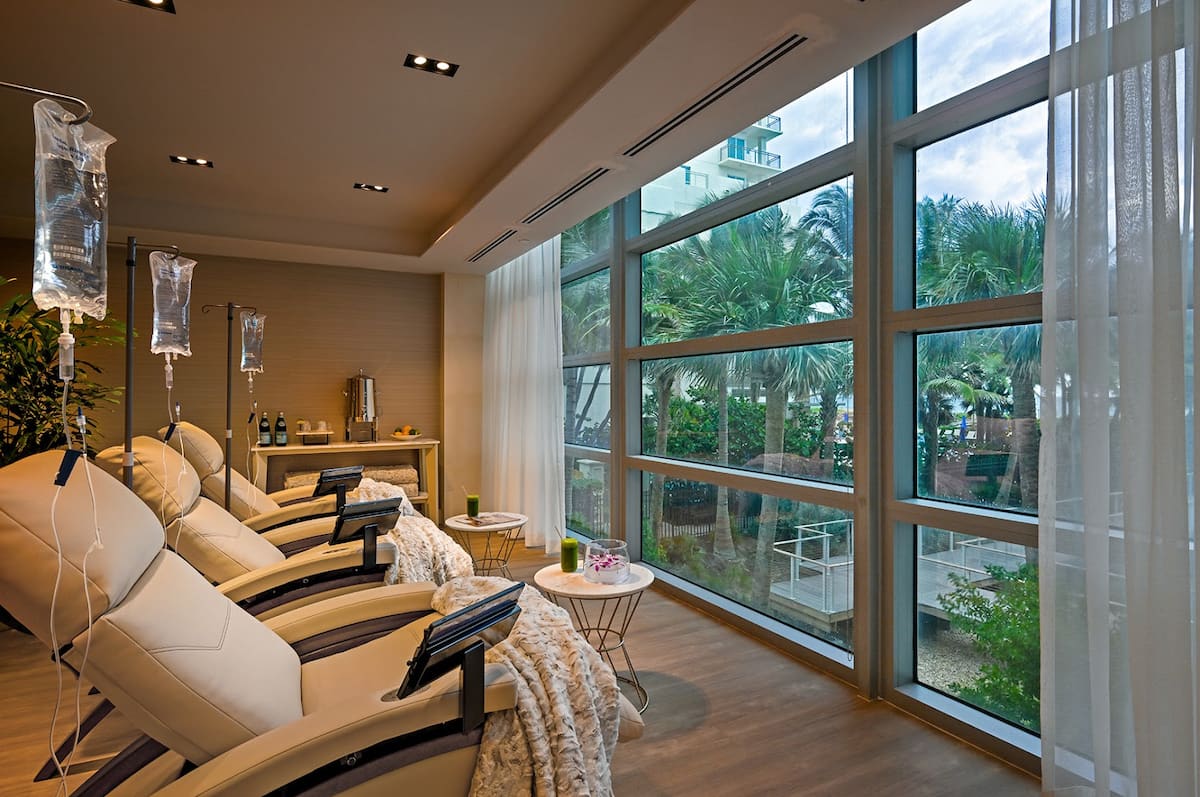
What sets the float below the residence apart is less the treatment than its address. It lives in the regenerative therapies suite of the roughly 100,000-square-foot wellness centre downstairs — the quiet, touchless wing that also holds hyperbaric oxygen, red light, PEMF and the IV lounge, kept apart from the busier hot-and-cold world of the Aayush hydrothermal circuit. It is a short elevator ride from OASENA, which changes how you can use it.
The dry float, specifically
Amrit offers the dry form of flotation: the warm, water-filled bed described throughout this guide, where you stay dry and clothed while your weight is lifted away. That choice fits the resort’s wider approach, which leans toward touchless, technology-assisted therapies alongside the traditional hands-on treatments and the bathing circuit. If you have floated before only in a salt tank, expect the same core sensation of weightlessness arriving by a very different, and for many people friendlier, route.
How it fits the rest of the menu
Because a dry float is dry and self-contained, it pairs unusually well with the rest of a wellness day:
- Before a massage, to arrive already unwound, so the bodywork starts from a deeper baseline.
- After the hydrothermal circuit, as the still, restful counterweight to the stimulation of hot rooms and cold plunges.
- Alongside the other regenerative therapies, where it makes a natural quiet anchor for a longevity-minded morning of PEMF, red light or an IV drip.
- On its own, as a single restful hour when the rest of the day is for the beach.
Residence guests reach the wellness centre at preferred rates, and access runs on the resort’s own terms and booking. Since the float is a scheduled, attended treatment rather than a walk-in station on the circuit, it is worth reserving ahead, especially in the busy winter season when the spa fills. A member of the spa team will settle you onto the bed, set your preferences for light and sound, and be nearby for the session.
If you are traveling as a group or a family, the float is easy to rotate through: it is a solo, self-contained hour, so one person can float while the others take a class, a treatment or the pool, and you can trade places through the morning without anyone waiting on anyone else.
One quiet luxury of doing this here rather than at a standalone float center is the absence of logistics. There is no drive across town, no unfamiliar building, no rush-hour return while you are still soft around the edges. You come down in the elevator, you float, and you go back up to a private residence with the Atlantic out the window. The treatment is the same one you could find elsewhere; the setting is what makes it easy to use.
A small honesty note belongs here too: the residence is privately owned and is not operated by or affiliated with the resort, so spa offerings, hours and access can change. Treat the wellness centre as a wonderful neighbor rather than a fixed feature of the rental, and confirm the current float options when you book.
10Folding a float into a Singer Island day
A float is best when it has room to breathe on either side, so the nicest versions of a float day are built around it rather than squeezing it in. Here are a few ways to fold one into a Singer Island stay.
The slow morning
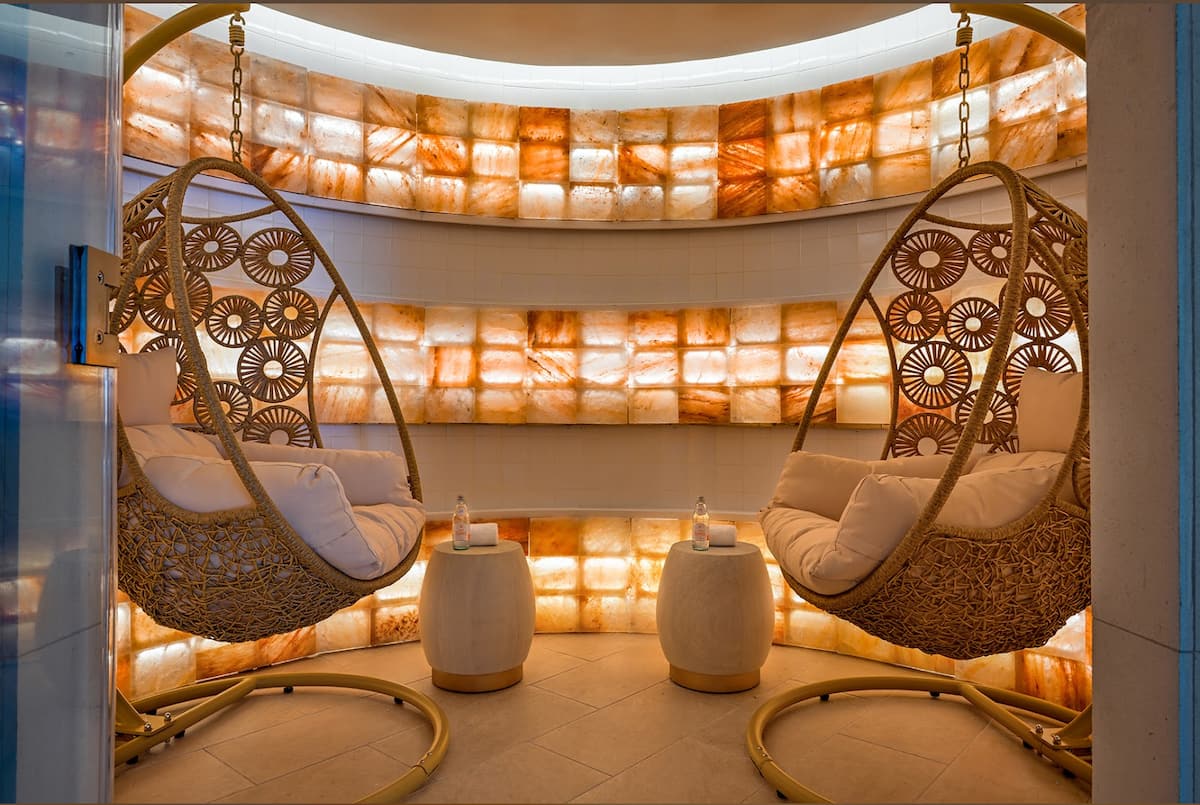
Come down mid-morning, before the beach heat peaks. Start warm in the hydrothermal circuit — a sauna, a brief cold plunge, a few minutes in the salt room — then move to the regenerative wing for your float as the still center of the morning. Finish with water on a lounger, then go back up, change, and take the rest of the day to the sand. You will have done more for your nervous system by noon than most vacations manage in a week, and spent almost no effort doing it.
The evening wind-down
Floating late has a particular payoff for sleep. Book an afternoon or early-evening session, keep dinner light and unhurried afterward — a quiet table at the resort’s own plant-forward restaurant, or something simple cooked in the residence kitchen — and let the calm carry you toward an early, easy night. This is an especially good move on your first evening, when travel has left you wired, or on the night before a long day out.
The recovery day
If your trip runs active — a morning diving the Blue Heron Bridge, a round of golf up in the Gardens, a long day out on a boat — a float is a fine way to let the body catch up. Offloading gravity after a hard effort feels earned in a way it never quite does on a lazy day, and pairing it with a massage in the same visit makes for a genuine recovery afternoon.
And do not overlook the obvious use: the gray afternoon. Florida gets its share of summer storms that roll in around three and clear by evening, and a float is a nearly perfect way to spend a wet hour that would otherwise be lost. When the weather turns the beach off, the wellness centre downstairs is the reason a rainy afternoon on Singer Island never has to be a wasted one.
A few practical notes
- Book ahead in high season. November through April is the busy stretch; treatment slots go early.
- Guard the hour after. The float is easy to waste by diving back into email; plan something gentle to follow it.
- Pair, don’t stack. A float plus one other treatment is a lovely day; four back-to-back therapies is a to-do list.
- Trade off on a two-bedroom stay. While one person floats, another can take the beach — then swap — which makes the whole day easier to share.
However you place it, treat the float as a comma in the day, not a destination — a deliberate pause between the ocean, the table and the sand that makes everything around it land a little softer. On the twelfth floor, with the Atlantic doing its own quiet work outside the glass, that pause is only ever an elevator ride away.
Common questions
Do I get wet during a dry float?
No. A dry float uses a waterproof membrane stretched over warm water, so you lie down in comfortable clothes and stay completely dry. There is no salt, no shower before or after, and nothing to rinse off — which is the main way it differs from a classic Epsom-salt float tank.
Will I feel claustrophobic?
The dry float is open to the room rather than sealed in a pod, and you can keep the lights on, so the closed-in feeling that puts some people off enclosed float tanks largely disappears. If stillness itself makes you uneasy, tell the spa team — a shorter first session with gentle sound often helps.
Does floating do anything, or is it just relaxing?
The most short answer is that the evidence is promising for stress, anxiety and sleep, mostly from small studies, and thin or unproven for bigger medical claims. It is a well-tolerated relaxation practice, not a medical treatment, and it should complement rather than replace any care your doctor provides.
How long is a session, and how often should I go?
A dry float usually runs about forty-five minutes to an hour. Many people describe a cumulative effect, so on a week-long stay two or three unhurried sessions woven into your spa days is a sensible rhythm — more restful than trying to do one every day.
A note on wellness & health
This guide is general information about therapies offered at the resort spa, not medical advice, diagnosis or treatment. Wellness services are elective and results vary from person to person. Talk with a qualified healthcare professional before starting any new therapy, especially if you are pregnant or managing a medical condition. OASENA is privately owned and is not operated by, affiliated with, or endorsed by Amrit Ocean Resort & Residences. Spa access is offered to residence guests at preferred rates, subject to the resort’s terms and availability.



Your quiet address above the Atlantic
OASENA is a private two-bedroom home on the twelfth floor of the Happiness Tower — floor-to-ceiling ocean views, a sweeping balcony, and this entire wellness world an elevator ride below.
OASENA is a privately owned residence within Amrit Ocean Resort & Residences and is not operated by, affiliated with, or endorsed by the resort. See credits & notes.