PEMF Therapy: Pulsed Electromagnetic Fields Explained
In the regenerative suite below the residence, a padded mat threaded with copper coils sends gentle magnetic pulses through the body. Here is what PEMF therapy is, where it came from in bone-healing medicine, what the research does and doesn't support, and how to try the mat well.
01What PEMF therapy is
Pulsed electromagnetic field therapy, almost always shortened to PEMF, is the practice of lying on a mat that sends brief, gentle magnetic pulses through your body. Woven into the mat is a set of copper coils. When a low, pulsing current runs through them, they generate a magnetic field that passes harmlessly through skin, muscle and bone. You feel little or nothing — perhaps the faintest flutter — and after twenty or thirty minutes you get up and go about your day.
It helps to be clear about the family this belongs to. The same basic physics — a pulsing magnetic field inducing a tiny electrical signal inside living tissue — underpins a serious piece of orthopedic medicine that hospitals have used since the 1970s to coax stubborn fractures to knit. The wellness version you meet in a spa is a gentler, lower-intensity cousin of that. It is not the hospital bone stimulator, and it is not the strong, focused magnetic pulse a neurologist uses on the brain. It is a mild, whole-body version meant for rest and recovery.
One distinction is worth drawing early, because it clears up a lot of confusion. PEMF is not the same as a static magnet — the copper bracelet or the magnetic insole. Those hold a fixed field and do not pulse; the evidence for them is weak. PEMF is different in that the field changes rapidly, switching on and off many times a second, and it is that pulsing that is thought to matter. Whether it matters as much as its proponents claim is a fair question, and one this guide takes seriously further down.
It also helps to know that PEMF is not one fixed thing but a whole spectrum of devices. At one end sit the medical bone stimulators, prescribed and worn against a specific injury. In the middle are the powerful clinical mats used in some sports-medicine and veterinary settings. At the gentle end — where a spa mat lives — the fields are weaker, the sessions shorter, and the aim is broad rest rather than a targeted repair. When you read about PEMF online, the strong claims and the strong devices tend to travel together, and it is easy to assume the mild mat inherits all of it. It does not, quite, and that gap is the theme this guide keeps returning to.
None of that should make the mat sound disappointing. It is simply a different tool for a different job. A bone stimulator exists to help fix something broken; a wellness mat exists to help a healthy person rest and recover. Judged as what it is — a low-effort, low-risk way to spend twenty quiet minutes — it holds up perfectly well. Judged as a medical device it does not belong to, it never could.
The short version
- What it is: a mat with coils that emit low-intensity, pulsing magnetic fields.
- What you feel: usually very little — a faint pulsing at most.
- How long: about twenty to thirty minutes, lying down.
- Where the idea comes from: orthopedic bone-healing devices, adapted for general wellness.
- What it is not: a medical treatment, a cure, or a replacement for your doctor.
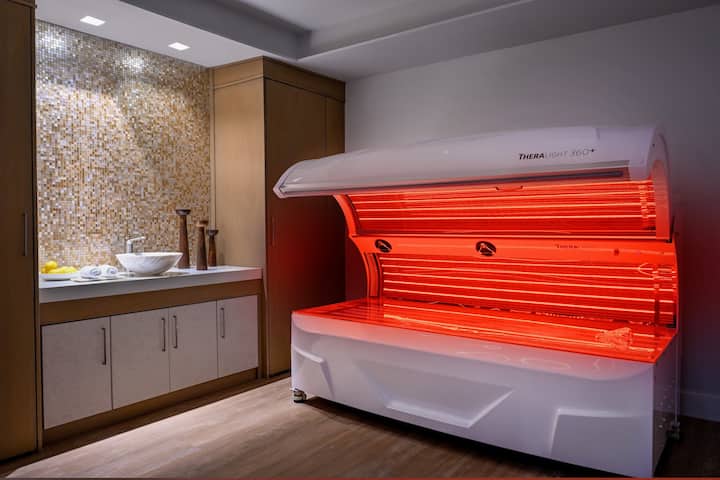
At Amrit, the mat lives in the regenerative therapies suite, a short elevator ride below OASENA, alongside the red-light room, the dry-float bed and the Ammortal chamber. It is one of the quietest things on offer there, and one of the easiest to fold into a slow morning.
02From a broken bone to a spa mat
PEMF has a more credible origin story than most wellness technologies, because it did not begin in a wellness setting at all. It began with a very old orthopedic puzzle: why do some broken bones simply refuse to heal? A fracture that fails to knit after months is called a non-union, and for a long time the only answers were repeated surgery or living with it. The path to PEMF started with a curious observation about bone itself.
In the 1950s, researchers in Japan showed that bone is piezoelectric — it generates tiny electrical charges when it is stressed and flexed. That finding lined up with a much older idea, Wolff's law, which holds that bone remodels in response to the loads placed on it. If mechanical stress speaks to bone in an electrical language, the reasoning went, perhaps an electrical or magnetic signal could speak back and prompt healing where a fracture had stalled.
Through the 1960s and 1970s, orthopedic surgeons and biophysicists — among them Andrew Bassett at Columbia and the well-known bone researcher Robert Becker — tested exactly that. They found that pulsed electromagnetic fields, applied over a non-healing fracture, could induce small currents in the tissue and, in a meaningful share of cases, help the bone finally close. In 1979 the U.S. Food and Drug Administration cleared PEMF devices for the treatment of fracture non-unions. Later clearances followed for use as an adjunct to spinal fusion surgery and for certain kinds of swelling and pain.
It is worth pausing on why bone, of all tissues, was the proving ground. Bone is unusual in that it visibly rebuilds itself throughout life, tearing down and laying down according to the loads it meets, which made it the ideal place to look for a signal that could tip the balance toward growth. Space agencies took an interest too, because astronauts lose bone density in weightlessness, and any method that might slow that loss was worth studying. Each of these threads reinforced the same core finding: a pulsing field could talk to bone in a language the bone understood.
How it left the hospital
Once the basic effect was accepted for bone, the idea spread outward. Veterinarians adopted PEMF for horses and dogs with soft-tissue and joint problems. Sports-medicine clinics began using it in recovery programs. And over the past two decades, lower-intensity whole-body mats moved into spas, gyms and homes, marketed for general wellness — better sleep, faster recovery, more energy.
This is the honest seam in the story, and it is worth naming clearly. The strong, specific medical evidence sits at the hospital end of that history, with bone healing. The broad, feel-good claims sit at the spa end, and they are supported by much thinner research. A modern wellness mat borrows the credibility of the orthopedic device it descends from, but it is being used for very different purposes and at much lower doses. Knowing where the strong evidence lives is the single most useful thing you can carry into a session.
03How it is thought to work
The proposed mechanism is elegant, and it rests on a piece of nineteenth-century physics you may remember from school: electromagnetic induction. A changing magnetic field, passing through a conductor, induces a small electrical current in it. Living tissue — salty, watery, full of charged particles — is a conductor. So when the mat's coils pulse, they induce faint electrical currents inside the body, without anything touching you and without any sensation of shock.
From there, the theory moves to the level of the individual cell. Every cell membrane holds a small voltage across it, maintained by the constant movement of charged ions — sodium, potassium, calcium — in and out through tiny channels. This membrane potential is not a quiet background detail; it governs how cells signal, divide and repair. The central PEMF hypothesis is that the induced micro-currents nudge this system: influencing ion transport, and especially calcium signaling, in a way that shifts cells toward repair and lower inflammation.
The main ideas researchers point to
- Membrane potential and ion channels. Small induced currents may affect how ions move across the cell membrane, altering the signals a cell sends and receives.
- Calcium and calmodulin. One well-studied pathway suggests PEMF influences calcium binding, which can ripple out to affect nitric oxide, blood flow and inflammatory signaling.
- Bone cells specifically. In fracture healing, the fields appear to encourage osteoblasts — the cells that build bone — which fits the original orthopedic use neatly.
- Cellular energy. Some researchers propose effects on mitochondria and ATP production, though this is more speculative than the ion-channel work.
A helpful way to picture the whole chain is to keep it at the scale it really operates on. The magnetic field itself is modest — you cannot feel it, and it passes through the body without warming the tissue the way a sauna or a heat lamp does. What it leaves behind is not heat but information: faint, flickering electrical currents that living cells are built to notice. The claim is not that the mat forces the body to do anything, but that it offers a signal the body's own repair machinery may choose to act on.
That framing also explains why frequency and waveform get so much attention in PEMF circles. If the effect is a matter of signaling rather than brute force, then the exact shape and rhythm of the pulse might matter as much as its strength — which is why different mats advertise different programs for rest versus recovery. It is a reasonable idea in principle. In practice, the science has not settled which frequencies do what for a healthy person, so treat any precise-sounding claim about a specific setting as a hypothesis rather than a proven prescription.
Two honest cautions belong here. First, a plausible mechanism is not proof of a benefit; the body is complicated, and effects seen in a dish or a stalled fracture do not automatically translate to a healthy person lying on a mat. Second, dose matters enormously. The frequency, intensity and waveform of the pulse all differ between a medical bone stimulator and a wellness mat, and results from one do not simply carry over to the other. When someone tells you PEMF is scientifically proven, the fair reply is: proven for what, at what dose, in whom? Those questions are exactly where the next section lives.
04What the evidence does and doesn't say
This is the section that separates a responsible guide from a sales pitch, so it is worth reading slowly. The evidence for PEMF is not empty, and it is not overwhelming. It is uneven — encouraging in a few narrow areas, and thin or mixed in the broad wellness territory where the mats are most heavily marketed.
Where the support is strongest
- Bone healing. This is the firmest ground, and it is where the whole field began. For fracture non-unions and delayed unions, and as an adjunct to spinal fusion, PEMF has decades of clinical use and FDA clearance behind it. This is a medical application, delivered by clinicians with specific devices — not what a spa mat is doing.
- Osteoarthritis pain. Several reviews of knee osteoarthritis have found that PEMF can modestly reduce pain and stiffness for some people. The effect is real but generally small, and study quality varies.
- Some post-surgical pain and swelling. There is reasonable evidence for reduced pain and edema after certain procedures, which is why some devices are cleared for exactly that.
Where the evidence is thin or mixed
- Sleep, energy and general wellbeing. These are the headline promises of most wellness mats, and they rest on small studies, short trials and a great deal of testimonial. Some people clearly feel better; whether that is the field, the enforced rest, or expectation is hard to separate.
- Athletic recovery. Popular with athletes, but the controlled data is limited and inconsistent.
- Depression, and serious disease of any kind. Be especially careful here. A strong, focused magnetic therapy called transcranial magnetic stimulation is an approved treatment for depression, but it is a different, medically supervised technology — not a wellness mat. No PEMF mat treats, reverses or cures any disease, and any claim that it does should end your trust in whoever is making it.
There is also a fair reason the wellness evidence stays murky, and it is not simply that researchers have been lazy. PEMF is hard to study well. The devices differ wildly in frequency, intensity and waveform, so a promising result with one machine tells you little about another. Good trials need a convincing sham — a mat that looks and feels identical but emits nothing — and because you cannot feel the real thing anyway, expectation is difficult to rule out. Sample sizes are often small, and funding often comes from the makers themselves.
None of this proves PEMF does nothing for general wellbeing; it means the honest verdict there is still open, and anyone claiming certainty in either direction is going beyond what the data can carry. The practical takeaway is a two-part rule you can apply to almost any wellness technology. First, ask where the strong evidence sits, and hold the therapy to that use rather than the broadest one. Second, notice who benefits from the claim; a testimonial from someone selling the mat is worth less than a trial that tried hard to prove itself wrong.
The reasonable position, then, is a modest one. PEMF is a well-tolerated wellness practice with a serious scientific pedigree at its medical edge and real limits at its wellness edge. Approach the mat as a pleasant, low-risk twenty minutes that some people find restful — not as a proven fix for anything. If you live with a specific condition, keep it as a complement to your medical care, never a replacement, and let your own doctor stay in charge.
The physics behind the spa mat is the same physics a surgeon trusts to help a broken bone knit — turned down low, spread across the whole body, and offered as rest rather than repair.
On the PEMF mat at Amrit
05What a session is like
The most surprising thing about a PEMF session, for most first-timers, is how little there is to it. There is no chamber to seal, no cold to brace against, no needle. You lie down on a well-padded mat — in comfortable clothes, shoes off — and that is essentially the whole setup. The attendant sets a program, dims the lights, and leaves you to rest for twenty to thirty minutes.
What you feel ranges from nothing at all to a very faint pulsing or tingling, depending on the intensity of the program and how attentive you are to it. At the low, wellness-oriented settings used on a whole-body mat, many people report no physical sensation whatsoever. The experience, in practice, is close to a guided lie-down: quiet, warm, unhurried, with the pleasant knowledge that you are meant to do nothing.
Because so little happens on the surface, the inner experience is really the whole of it, and people meet it differently. Some treat the half hour as a nap and drift off entirely; the attendant will usually rouse you gently when the program ends. Others use it as a rare window for a slow body scan or a few minutes of unhurried breathing, letting the enforced stillness do the work a busy day never allows. There is no correct way to spend the time. The only mistake is to fill it — to bring the phone, answer messages, and turn a rest into another task.
It is also worth knowing what will not happen, so nothing catches you off guard. You will not feel heat, you will not feel a jolt, and you will not need to shower or change afterward as you might with a hydrothermal session. You can dress and step straight back into the day. If at any point the faint pulsing of a stronger program feels unpleasant rather than neutral, say so; the setting can be lowered, and there is nothing to prove by enduring a sensation you do not enjoy.
A few practical notes
- Leave the metal behind, and the electronics too. You will usually be asked to set aside your phone, watch and anything with a magnetic strip, and to remove bulky jewelry. This is partly to protect the devices and partly good practice around a magnetic field.
- Programs vary. Some mats offer settings framed as more energizing or more relaxing, using different frequencies. Tell the attendant if your aim is rest before sleep rather than a midday reset, and follow their guidance on intensity.
- Hydrate. As with most of the regenerative therapies, a glass of water before and after is sensible, and it pairs the session with the rest of a spa morning.
- Give yourself a soft landing. Because the point is rest, it is a waste to leap straight from the mat into a busy afternoon. Let it flow into a lounge, the terrace, or a slow walk.
Afterward, honest reports differ. Some people feel notably calm or sleepy, others feel a mild lift, and a fair number feel much as they did before but pleasantly rested from having lain still and screen-free for half an hour. All of these are normal. The mat is a low-drama therapy, and part of using it well is arriving without the expectation of a dramatic result.
06What people report and why
Set the strongest medical claims aside for a moment and ask a simpler question: what do people say after a PEMF session? The answers are worth taking seriously on their own terms, even where the controlled science is still catching up, because they tell you what the mat is realistically good for as a wellness practice.
The reports that come up most
- A sense of calm and easier sleep. Many people describe feeling settled afterward, and some find they sleep more soundly on nights they have used the mat. A relaxing evening program is often chosen with exactly this in mind.
- Less stiffness and more comfortable joints. Guests with ordinary aches — a travel-stiff back, a cranky knee — sometimes report feeling looser. This lines up, at least loosely, with the modest osteoarthritis findings noted earlier.
- Recovery after exertion. Active guests who have pushed hard on the water or the courts often use the mat as a recovery ritual and say they feel readier the next day.
- Simple, deep rest. Perhaps the most common and most defensible report of all: half an hour of doing nothing, in a quiet room, with no screen, is restorative regardless of the field.
It is worth noticing what these reports have in common and what they lack. They cluster around comfort, calm and recovery — the ordinary business of a body unwinding — and they are almost always described in gentle, cumulative terms rather than dramatic ones. Nobody honest tends to call a single session transformative. What you hear instead is the language of small margins: a slightly easier night, a back that loosened sooner than expected, a day that felt a touch more recovered.
The role of expectation deserves to be named rather than hidden, because it is often treated as an insult when it is really just biology. Believing a treatment will help changes how you feel; that is a real effect in a real nervous system, not a trick. For a healthy person seeking rest, a benefit that flows partly from the field and partly from the belief and the quiet is still a benefit worth having. The honesty simply lives in not overselling its source. A calmer evening is a calmer evening; it does not need to be credited entirely to the coils to be worth twenty minutes of your morning.
That last point deserves respect rather than dismissal. Some of what people feel is very likely the field, some is the deep relaxation the setting enforces, and some is expectation — the well-documented tendency to feel better after a treatment we believe in. For a healthy person seeking rest and recovery, it does not greatly matter how the benefit is apportioned, because the practice is low-risk and the rest is real either way.
Where it does matter is in what you ask of it. A calmer evening, a looser back, a good half-hour of quiet — these are reasonable things to hope for. A cure, a reversal of disease, a replacement for medication or physical therapy — these are not, and no honest account of PEMF will promise them. Keeping your expectations in the first list and out of the second is the difference between a mat that pleasantly earns its place in your day and a claim that oversells itself.
07Who it suits — and who must ask first
For most healthy adults, a low-intensity PEMF mat is a benign thing to try. It suits travelers carrying stiffness and poor sleep, active guests looking for a recovery ritual, and anyone who simply wants a quiet, undemanding half hour that asks nothing of them. It pairs easily with the rest of a wellness day and requires no particular fitness or preparation. But PEMF is one of the therapies where the contraindications are firm and specific, so this section matters more than usual.
Start with the good news, because for most guests it applies. If you are a generally healthy adult with no implanted devices, PEMF carries very little known risk, and the worst common outcome is that you feel pleasantly rested but notice nothing more. There is no recovery time, no aftereffect to plan around, and nothing that stops you swimming, dining or driving afterward. That easy safety profile is part of why the mat suits travelers so well.
But easy is not the same as universal, and the list below is one to read carefully rather than skim, because a couple of the cautions are firm rather than merely precautionary. The line about implanted electronic devices in particular is not a suggestion; it exists because a pulsing magnetic field and sensitive medical electronics do not safely mix. If you are ever unsure whether something you carry in your body counts — an old surgical implant, a monitor, a pump — the right move is to assume it does and ask, not to guess. A short question to your doctor is a small price for using any of these therapies with a clear mind.
Who should not use a PEMF mat without medical clearance
- Anyone with a pacemaker, implanted defibrillator, or any implanted electronic device. This is the most important line. A pulsing magnetic field can interfere with the electronics that keep such devices working correctly. The same caution applies to insulin pumps, cochlear implants, deep-brain stimulators and similar hardware. If you have any electronic implant, do not use PEMF unless your own physician and the device maker have specifically cleared it.
- Anyone who is pregnant. PEMF has not been established as safe in pregnancy, so the responsible default is to skip it entirely and choose one of the many gentle alternatives instead.
- Anyone with active bleeding or a bleeding disorder. Because part of the proposed mechanism involves circulation, PEMF is generally avoided where there is active hemorrhage, a recent bleed, or a clotting problem.
- People with epilepsy or a seizure history. Ask a neurologist first; pulsing fields warrant caution.
- Anyone with a serious or unstable condition, or an active cancer under treatment. Not because PEMF is known to be harmful, but because these situations call for your doctor's judgment rather than a spa's default program.
Outside those groups, the practice is low-risk. The sensible rule holds across all of these wellness pages, and it holds especially firmly here: if you are pregnant, manage a serious condition, or carry any implanted electronic device, ask your doctor before you book. The staff at the wellness centre can tell you what a session involves, but they cannot know your medical history, and only your physician can weigh it against your specifics. When in doubt, the safe answer is simple — leave the mat for this trip and enjoy the sauna, the salt room or a massage instead.
08The PEMF mat below the residence
What makes the mat here easy to try is, more than anything, its address. It sits within the roughly 100,000-square-foot wellness centre one elevator ride below OASENA, in the cluster of touchless, technology-forward therapies the resort groups as its regenerative offerings. That cluster is worth picturing as a whole, because the PEMF mat rarely stands alone in a good wellness morning.
The regenerative neighbors
Alongside the mat, the same suite is home to several therapies that share its low-effort, lie-back character:
- The Ammortal Recharge Chamber — a multi-modality station that itself combines light, sound and vibration, breath training, molecular hydrogen and, notably, its own PEMF element.
- Red light therapy — photobiomodulation, another painless, sit-still session studied mainly for skin and recovery.
- Dry flotation — the gravity-offloading rest of a float without the water, which many people pair with the mat for a deeply quiet hour.
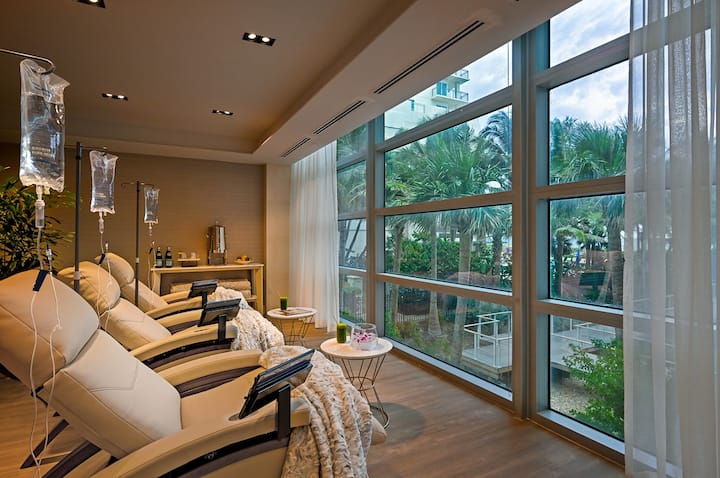
- Hyperbaric oxygen therapy and IV nutrient infusions — the more clinical end of the regenerative menu, offered nearby.
Because the resort's wider signature is the self-guided Aayush hydrothermal circuit — hot and cold plunge pools, a sauna, a salt inhalation chamber, an effusion shower and a hydro-reflexology path, meant to take ninety minutes to two hours — the PEMF mat becomes a natural quiet counterpoint to all that heat and cold. Move through the water and temperature stations, then let the mat be your still, warm finish.
The scale of the place is worth a word, because it changes how you use any single therapy in it. The wellness centre runs to roughly 100,000 square feet and holds 22 treatment rooms, so the mat is one small station inside a large facility rather than the whole show. That size is an advantage for a therapy as low-key as this one: you are never building a special trip around the mat, only adding twenty quiet minutes to time you were already going to spend downstairs.
The convenience of the address is easy to underrate until you have lived it for a few days. There is no membership to arrange, no drive across town in the heat, no negotiating a parking lot with a beach bag. You step out of the residence, ride down, and you are there; when you are done, the same short ride puts you back on your own balcony. For a therapy whose entire value is rest, removing every scrap of friction around it matters more than it sounds. Half the reason the mat works on a stay like this is simply that nothing about reaching it undoes the calm it is meant to build.
Residence guests reach the wellness centre at preferred rates, and access is arranged through the resort under its own terms and booking windows. Two practical notes are worth keeping in mind. First, because the mat is a scheduled therapy rather than a walk-in station like the plunge pools, it is worth asking about availability when you plan your spa time rather than assuming you can drop in. Second, the residence is privately owned and is not operated by or affiliated with the resort; the wellness centre is a neighbor you have wonderfully convenient access to, not a service of the residence itself. Treated that way — as a remarkable amenity one floor down — it is one of the simplest luxuries of staying here.
09Folding it into a Singer Island day
The mat is at its best as a small, deliberate pause inside a fuller day, not as an event you build a morning around. Because it lives one elevator ride below the residence, you can use it without a car, a drive or a booking scramble — which means it slots into the rhythm of a beach day rather than interrupting it. Here are two shapes that work well.
The slow wellness morning
- Come down mid-morning, before the beach heat peaks.
- Walk the Aayush circuit first — warm in the sauna, brace in a cold plunge, drift through the salt room — so your body is loose and your mind already unhurried.
- Book the PEMF mat as the still center: twenty to thirty minutes flat, screen-free, doing nothing.
- Finish on the terrace with water and the Atlantic in front of you, then go back up to the residence for a late, slow breakfast.
The recovery evening
- Spend the day on the water — a snorkel at the Blue Heron Bridge on the high slack tide, a reef trip, a long swim off the private beach.
- Late afternoon, use the mat on a calmer, rest-oriented program, aiming it at unwinding rather than energizing.
- Head up, open the balcony doors to the sea air, and let an early, easy night follow. If sleep is what you are after, this is the sequence to try.
Either shape works better when it is not squeezed. The one thing the mat needs from you is time it will not be rushed out of, and that is easy to protect here precisely because the therapy lives downstairs rather than across town. There is no drive to time, no traffic to beat, no parking to find — the whole cost of the session is the twenty or thirty minutes on the mat itself. On a longer stay, two or three unhurried sessions woven through the week tend to sit better than one anxious appointment jammed against a dinner reservation.
A word on rhythm across a full trip. Because the mat asks so little and leaves no aftereffect, there is no need to ration it the way you might a heavy massage or a hard cold plunge. If it earns a place in your day, let it recur; if it does nothing for you, drop it without ceremony and spend the time on the water instead. The measure of any of these therapies on a holiday is honest and simple — did it make the day better? — and the mat should be held to exactly that test, no more and no less.
A few closing habits make either version better. Keep the session unhurried; the whole point is undoing the day's pace, so resist scheduling it against a hard deadline. Drink water around it. And hold your expectations gently — treat the mat as twenty reliable minutes of rest with a possible bonus, rather than a switch that must flip. Used that way, it earns its small place in the day.
Above all, remember what you have upstairs. The finest recovery tool at OASENA is not any single machine but the balcony itself: the ocean air, the horizon, and the quiet of the twelfth floor. The mat is a pleasant way to spend part of a morning below. The Atlantic is why you came.
10How it compares to the other regenerative therapies
Guests often arrive at the regenerative suite with limited time and a simple question: with so many touchless therapies on offer, which should I try, and how do they differ? PEMF is easiest to understand when you set it beside its neighbors, because each answers a slightly different want, and choosing well beats sampling everything at random.
A quick way to tell them apart
- PEMF mat — magnetic pulses, whole-body, lying down. Best framed as deep rest and general recovery, with its strongest science far away at the bone-healing end of its history. Choose it when you want to do nothing and rest.
- Red light therapy — light on the skin, working through the mitochondria. Best evidence sits with skin and some muscle recovery. Choose it if skin and surface recovery are your interest.
- Dry flotation — the body floats, gravity eases, sensory load drops. Best studied for stress and calm. Choose it when your nervous system, more than your muscles, needs the break.
- The Ammortal chamber — a bundle of modalities at once, PEMF among them. Newer and more proprietary, with correspondingly less independent evidence. Choose it out of curiosity about the combined-technology idea, with your expectations kept in check.
- Hyperbaric oxygen and IV infusions — the clinical end of the menu, with the strongest support in specific medical uses rather than general wellness.
Two honest through-lines connect all of them. The first is that each has a serious, narrow zone where the evidence is real and a broad, hopeful zone where marketing runs ahead of the data; a good guest learns to tell the two apart for each therapy. The second is that a large share of what people love about any of these is shared and unglamorous — a quiet room, an enforced pause, permission to rest — and that is available in all of them, PEMF included.
One more comparison people ask about deserves a plain answer: how does the wellness mat relate to the medical bone stimulator that shares its physics? The honest reply is that they are relatives, not twins. The medical device is prescribed, targeted at a specific injury, and backed by the strong evidence discussed earlier. The wellness mat is broader, gentler and aimed at rest and general recovery, and it borrows the family name more than the clinical results. Neither is a fraud, but they answer different questions, and it is a mistake to hand the mat the credit that belongs to the stimulator.
The same clear-eyed sorting works across the whole suite, and it is the most useful habit you can bring downstairs. For each therapy, hold two facts in mind at once: the narrow thing it is good at, and the broad promise the marketing has draped over it. Choose based on the first, enjoy the second only if it happens, and keep your own doctor in charge of anything that touches a real medical condition. Do that, and the regenerative suite becomes what it should be — a pleasant, low-pressure set of ways to rest, not a set of cures to believe in.
If you have time for only one and rest is your aim, the PEMF mat and dry flotation are the gentlest, lowest-effort choices. If skin is your interest, start with red light. And if you are simply curious about the whole idea of technology-assisted recovery, an unhurried loop through the Aayush circuit followed by one quiet session on the mat is a fine, honest introduction — low-risk, pleasant, and asking nothing of you but half an hour of stillness.
Common questions
Does PEMF hurt, or will I feel a shock?
No. The field passes through the body without touching you, and there is no shock. At the low, wellness-level settings used on a whole-body mat, most people feel nothing at all — a faint pulsing or tingling at most. You simply lie down and rest for twenty to thirty minutes.
Can I use the PEMF mat if I have a pacemaker or an implant?
No, not without specific medical clearance. A pulsing magnetic field can interfere with pacemakers, defibrillators, insulin pumps and other implanted electronic devices. If you have any electronic implant, are pregnant, or have active bleeding, do not use PEMF unless your doctor has cleared it. When in doubt, choose the sauna, salt room or a massage instead.
Is PEMF proven to work?
It depends what you mean. There is solid, decades-old medical evidence that PEMF helps certain bone fractures heal, and modest evidence for osteoarthritis pain. The broad wellness claims — better sleep, more energy, faster recovery — rest on much thinner research. Treat the mat as a pleasant, low-risk rest with a serious scientific pedigree at its medical edge, not as a proven cure for anything.
How is the mat different from a magnetic bracelet?
Quite different. A bracelet or insole holds a static magnet with a fixed field, and the evidence for those is weak. PEMF uses a field that pulses on and off many times a second, and it is that pulsing — and the tiny electrical currents it induces in tissue — that researchers study. It is closer in principle to a medical bone stimulator than to a novelty magnet.
A note on wellness & health
This guide is general information about therapies offered at the resort spa, not medical advice, diagnosis or treatment. Wellness services are elective and results vary from person to person. Talk with a qualified healthcare professional before starting any new therapy, especially if you are pregnant or managing a medical condition. OASENA is privately owned and is not operated by, affiliated with, or endorsed by Amrit Ocean Resort & Residences. Spa access is offered to residence guests at preferred rates, subject to the resort’s terms and availability.


Your quiet address above the Atlantic
OASENA is a private two-bedroom home on the twelfth floor of the Happiness Tower — floor-to-ceiling ocean views, a sweeping balcony, and this entire wellness world an elevator ride below.
OASENA is a privately owned residence within Amrit Ocean Resort & Residences and is not operated by, affiliated with, or endorsed by the resort. See credits & notes.