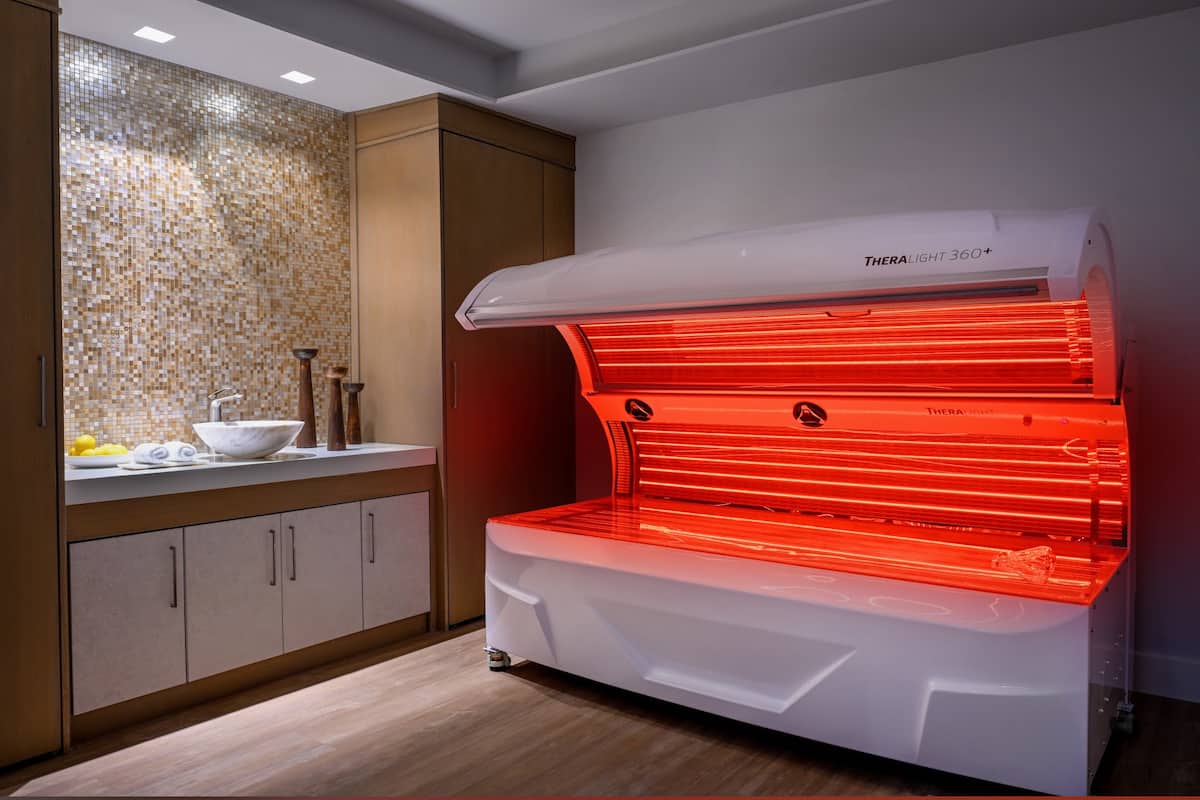
Red Light Therapy and Photobiomodulation Explained
A short, painless session in front of a panel of red and near-infrared light. Here is what photobiomodulation is, how it grew from laboratory lasers and NASA plant research into a spa fixture, what the science does and doesn't support, and how to use the red-light suite below the residence well.
01What red light therapy is
Red light therapy is the practice of sitting in front of a panel of bright red and near-infrared light for a short, quiet stretch of time. There is no needle, no meaningful heat, and nothing to swallow or apply. You expose bare skin to specific wavelengths of light, a little the way you might sit in a patch of morning sun, except the light here is tuned to a narrow band that researchers believe your cells can put to use. The more technical name for it is photobiomodulation, and it describes any use of low-level red or near-infrared light meant to nudge the body’s own processes rather than to cut, burn or medicate.
It helps to say clearly what it is not. It is not a tanning bed and it is not a sunlamp. The wavelengths used carry no ultraviolet, so they do not tan the skin or cause a sunburn. It is not the kind of laser used to resurface skin, and it is not a cure for any disease. It sits in the calm middle ground of the modern spa: a painless, well-tolerated session that many people find leaves their skin looking a little brighter and their muscles feeling a little looser, supported by a real and growing body of science for a few specific uses and by a great deal of marketing enthusiasm for nearly everything else.
If the whole idea sounds far-fetched — that light alone could change anything inside you — it is worth remembering how much of your biology already runs on light. Sunlight sets your body clock, drives the vitamin D your skin makes, and lifts your mood on a bright morning. Plants live on it. Red light therapy is a narrower, tamer cousin of all that: a specific slice of the spectrum, at a low dose, aimed at a specific job. That does not make every claim true, but it does make the basic premise ordinary rather than exotic. Your cells are built to respond to light. The only real questions are which wavelengths, at what dose, do something you would notice.
The short version
- What you feel: a gentle warmth and a lot of red glow. Most people describe it as relaxing and completely painless.
- What it uses: red light in roughly the 630 to 660 nanometer range and near-infrared light around 810 to 850 nanometers, delivered by banks of LEDs or, in clinical settings, by low-level lasers.
- What it is studied for: skin quality and wound healing, some kinds of muscle recovery and joint or muscle soreness, and hair growth, with weaker or still-emerging evidence for most other claims.
- Where it lives here: among the touchless regenerative therapies in the wellness centre below the residence, a short elevator ride down.
The rest of this guide walks through where the idea came from, what is happening at the level of your cells, and — the part most brochures skip — where the evidence is encouraging and where it is still thin. The aim is that you step into the red-light suite knowing exactly what to expect, and exactly what not to expect. Light is a strange thing to sell as a therapy, and the honest story is more interesting than the hype anyway. It is a story that runs from a Hungarian laboratory in the 1960s, through a plant-growth experiment aboard the Space Shuttle, to a warm, glowing room a few floors beneath a twelfth-floor balcony on the Atlantic.
02From laboratory lasers to NASA seedlings
The story usually starts in 1967, in Budapest, with a physician and researcher named Endre Mester. He was testing whether a low-powered laser could shrink tumors in mice, and to run the experiment he shaved patches of skin on the animals. The tumors did not do what he expected, but he noticed something else: on the treated mice, the shaved hair grew back faster, and small wounds seemed to close more quickly than on the untreated ones. He called the effect laser biostimulation, and it became the seed of a whole field. For decades the practice was known as low-level laser therapy, or LLLT, and it lived mostly at the edges of physical therapy and dentistry.
The second thread came from an unlikely place. In the 1980s and 1990s, NASA was experimenting with red light-emitting diodes as a way to grow plants on long space missions, since certain red wavelengths drive photosynthesis efficiently. Researchers working with those bright LED arrays observed that they also seemed to speed the healing of skin and tissue, and NASA-funded studies went on to look at red and near-infrared light for wound care and for the mouth sores that trouble some cancer patients. That research helped move the idea away from expensive lasers and toward cheap, safe, broad panels of LEDs — the same technology that now fills a spa red-light room.
How the name kept changing
- Laser biostimulation was Mester’s original term for the effect he stumbled onto in 1967.
- Low-level laser therapy (LLLT) carried the practice through the following decades, when lasers were the only practical source.
- Photobiomodulation (PBM) is the term researchers settled on more recently, because it does not assume a laser, works for LEDs, and better describes what the light is thought to do: modulate biology rather than heat or ablate tissue.
From there the path into everyday life was mostly a story of falling prices. As LEDs became bright, cheap and reliable, red-light panels moved out of physical-therapy clinics and dermatology offices and into gyms, med-spas, and eventually the shelves of ordinary stores and the bags of traveling athletes. Regulators cleared certain devices for narrow purposes, such as easing minor muscle and joint pain, improving the look of the skin, or treating a common pattern of hair loss. That clearance is often quietly stretched by marketers into far broader promises, which is one reason the same underlying technology can appear both in a serious clinic and in a wildly overhyped online advertisement.
None of this history should be read as proof that every modern claim holds up. What it does show is that the core observation — that a certain kind of low-level red and near-infrared light can influence living tissue — is old, was found by accident more than once, and has been studied seriously by serious institutions. The gap between that grounded core and the sweeping promises now printed on consumer devices is exactly the gap this guide is trying to keep honest. When you sit in the red-light suite below the residence, you are at the end of a line that runs from a Budapest mouse cage and a shelf of glowing space-station seedlings to a comfortable chair above the sea. The room is new. The observation behind it is nearly sixty years old.
03How it is thought to work
To understand red light therapy you have to go down to the level of the mitochondria — the small structures inside nearly every cell that turn food and oxygen into usable energy. The leading explanation for photobiomodulation centers on a single molecule in the mitochondria called cytochrome c oxidase. It is the last stop in the chain of reactions that produces cellular energy, and it happens to absorb red and near-infrared light especially well. In the language of the field, it is a chromophore: a molecule that catches light of particular wavelengths.
The proposed sequence goes something like this. Red or near-infrared photons reach the tissue and are absorbed by cytochrome c oxidase. That absorption is thought to release nitric oxide that had been slowing the enzyme down, which lets the energy-producing chain run more freely and raises the cell’s output of ATP, its basic fuel. Alongside the extra energy, the light appears to trigger a brief, mild rise in reactive oxygen species and a release of nitric oxide into the local blood vessels, both of which act as signals. The nitric oxide can widen small vessels and improve local blood flow; the mild oxidative signal can switch on the cell’s own repair and anti-inflammatory programs. The idea, in short, is not that light adds anything to the body, but that it gently prompts the cell to do more of what it already does.
Why a little stress can help
Much of this fits a broader pattern in physiology called hormesis: a small, well-judged dose of stress that provokes a healthy adaptive response, the same principle behind exercise, sauna heat and a cold plunge. A modest pulse of light energy asks the cell to tune up its housekeeping. That framing matters, because it explains one of the most important and least advertised facts about red light therapy.
- The dose is not "more is better." Researchers describe a biphasic response: too little light does nothing, an appropriate dose helps, and too much can blunt the effect. This is why longer or more intense is not automatically better.
- Depth depends on wavelength. Red light in the 630 to 660 nanometer range is absorbed near the surface, which suits the skin. Near-infrared around 810 to 850 nanometers passes deeper, toward muscle and joints, which is why recovery panels lean on it.
- It is a signal, not a burn. The energy involved is low. The point is to be read by the cell, not to heat or damage the tissue.
One more piece helps explain why these particular colors matter. Tissue is fairly transparent to red and near-infrared light but absorbs most other wavelengths quickly — blood soaks up blue and green, water soaks up far-infrared. That leaves a so-called optical window, roughly 600 to 1000 nanometers, where light can travel a useful distance into the body before it is absorbed or scattered away. Red light therapy lives inside that window on purpose. It is not that these wavelengths are magic; it is that they are among the few that can reach living tissue at all without being swallowed up in the first millimeter of skin.
It is worth being honest that this mechanism, while well supported in the laboratory and widely accepted, is still an area of active research. Scientists agree that light in these bands does something measurable to cells; the precise chain of cause and effect in a living human, and how reliably it produces a benefit you would notice, is exactly where the certainty thins out.
04Red, near-infrared and the question of dose
Not all red light is the same, and the differences are more than cosmetic. Two things mostly determine what a session can and cannot do: the wavelength of the light and the dose delivered to the tissue. Getting a feel for both makes it much easier to read past the marketing on any panel you meet, in a spa or in a store.
Wavelength: color as depth
The visible red band, roughly 630 to 660 nanometers, is the light you can see glowing. It is absorbed close to the surface and is the wavelength most associated with the skin: tone, texture, collagen and superficial healing. Near-infrared light, in the 810 to 850 nanometer range, is invisible to the eye but penetrates further, reaching muscle, connective tissue and joints. That is why panels aimed at recovery and soreness rely on the near-infrared band, and why many good devices combine the two. If a claim depends on reaching a muscle or a joint but the device only offers surface-level red, the physics simply does not line up.
Dose
Dose is measured as energy delivered per unit area, and it depends on three things at once: how bright the panel is, how close you sit, and how long you stay. Because the response is biphasic, there is a window — not a ladder. A useful way to hold it in mind:
- Too little and the light never does enough to register as a signal.
- A reasonable dose lands inside the helpful window, which is why clinical panels specify a distance and a time.
- Too much, whether from sitting too close or staying far too long, can flatten the benefit rather than double it.
This is the single most useful thing to understand, because it corrects the instinct that a stronger, longer, closer session must be better. It is also why a well-run spa suite sets a distance and a timer rather than letting you bake in front of a panel. A typical session runs about ten to twenty minutes; more is not a bonus.
You will also see devices advertise features that sound scientific but matter less than the basics. Some pulse the light on and off; some claim a special mix of extra wavelengths. The research on those refinements is far less settled than the core facts of wavelength and dose, so it is fair to treat them as marketing until proven otherwise. When you are sizing up any panel, the two questions that count are simple: what wavelengths does it emit, and is it being used at a sensible distance for a sensible time. Get those two right and the finer claims rarely change the outcome by much.
Two more distinctions are worth keeping straight. First, LED versus laser: the earliest research used lasers, but modern LED panels cover a broad area safely and cheaply, and for most wellness uses the difference in outcome is modest. Second, red light therapy versus infrared saunas. They are often confused because both feel warm and both invoke the word infrared, but they are different things. An infrared sauna works mainly by gentle heat and the body’s response to it; a red-light panel works by delivering specific wavelengths at low energy, with the warmth largely a side effect. Knowing which you are using tells you what to expect from it.
You sit in the glow, you do nothing, and a narrow band of light that your cells happen to know how to read goes quietly to work. The evidence is real in a few places and thin in others, and it is worth knowing which is which.
On the red-light suite at Amrit
05What the evidence does and doesn't say
This is the section worth reading slowly, because red light therapy is a field where the marketing has run well ahead of the science in some places while resting on solid ground in others. The honest summary is that the evidence is real and reasonably encouraging for a short list of uses, mixed or preliminary for a longer one, and thin to absent for many of the sweeping claims made online.
Where the support is reasonably good
- Skin. Multiple studies suggest red and near-infrared light can improve skin tone and texture, soften fine lines and support the skin’s collagen, and there is decent evidence for its use in wound healing. This is among the better-supported uses.
- Muscle and joint soreness, and recovery. A number of trials point to modest benefits for exercise recovery, muscle performance and certain kinds of musculoskeletal pain, which is why athletes and physical therapists have taken an interest. The effects tend to be real but moderate, not dramatic.
- Hair. For a common pattern of hair thinning, low-level light devices have shown enough benefit that some are cleared for that use, though results vary and are gradual.
- A specific medical use. Photobiomodulation has meaningful evidence for easing the painful mouth sores some cancer patients develop during treatment — a reminder that the underlying effect is real when the target and dose are right.
Where it is mixed, early or overstated
Beyond that list, the ground gets softer. Claims about melting body fat, treating serious systemic disease, sharpening cognition, balancing hormones or slowing aging in any broad sense are, at best, based on small or preliminary studies and, at worst, pure salesmanship. Many trials are small, short, funded by device makers, or hard to compare because the wavelength, dose and device all differ from one study to the next. That inconsistency is a real limitation, and any guide that pretends otherwise is not being straight with you.
It is worth understanding why the research is so uneven, because it tells you how to read any new headline. Studies use different devices, wavelengths, doses, distances and session lengths, which makes them hard to compare; a good result with one setup does not transfer cleanly to another. Many trials are small, run for only a few weeks, and are funded by the companies that sell the machines. Positive findings tend to get published and shared more eagerly than dull or negative ones. None of that means the field is bogus — the strong areas are strong for good reasons — but it does mean a single dramatic study, especially one quoted in an advertisement, deserves patience rather than a purchase.
The reasonable position, then, is a modest one. Red light therapy is a well-tolerated wellness practice with a solid basis for skin and some recovery uses, and a lot of unproven promise attached to it elsewhere. Treat it as a pleasant complement to good habits and, where relevant, to your doctor’s care — never as a substitute for either. If a claim sounds like it would be front-page news were it true, it probably has not cleared that bar yet.
06What a session is like
There is very little to it, which is part of the appeal. You come to the regenerative therapies area, and depending on the setup you either stand or sit in front of a large panel of red LEDs, or lie on a bed lined with them. To let the light reach your skin, you expose whatever area is being treated — face, back, shoulders, legs — while staying comfortable. The panel switches on, and the room fills with a deep, even red glow. You feel a mild, pleasant warmth, nothing more. There is no sting, no cold, no pressure. Most people simply relax, breathe slowly and let the ten to twenty minutes pass.
Your eyes and a few small comforts
The light is bright, and while red and near-infrared wavelengths are not the ultraviolet light that damages skin and eyes, staring directly into a strong panel is uncomfortable and unnecessary. Sensible practice is easy:
- Protect your eyes. Close them, look away from the panel, or wear the goggles the spa provides. Comfort is the main reason; there is no need to strain against a bright light.
- Bare, clean skin works best. Heavy makeup, thick lotions or sunscreen can sit between the light and your skin. Come with the treatment area clean, or clean it there.
- Mind the distance and the clock. Because the dose has a helpful window, follow the suggested distance from the panel and let the timer, not ambition, end the session.
- Hydrate and be gentle after. There is no recovery to speak of, but a glass of water and an unhurried transition are always welcome.
Afterward, most people feel calm and, if anything, a touch warmed and loosened. There is no downtime and nothing that stops you going straight to the beach or to lunch, though the light does not make your skin more sun-sensitive, so normal sun sense still applies once you are outside. If you are using it for your face, the effect people describe — a slightly fresher, more even look — tends to show up gradually over repeated sessions rather than all at once. If you are using it for tired legs after a long travel day or a hard swim, you may notice they feel a little less heavy.
The experience does not vary much from person to person, which makes it an easy first thing to try if you are new to the wellness centre. There is no tolerance to build up, no breathing technique to learn, no cold to brace against. If you are treating your face, you may sit close to a smaller panel; if you are easing a sore back or tired legs, you may lie under a larger array or stand before a full-height one. Either way the staff set you at the right distance and start a timer, and your only task for the next few minutes is to sit still in the glow and let the room be quiet.
A single session is a fine thing to try. But red light therapy, like most of these practices, rewards consistency. The people who report the clearest results tend to be the ones who fold several short sessions into a week rather than expecting one long exposure to do the work. On a stay of any length, a handful of relaxed visits woven around your other spa time is a sensible rhythm, and an easy one when the suite is a few floors below where you are sleeping.
07What people report
Set against the evidence, it is worth hearing what people say they feel, because the two do not always match perfectly and both are useful to know. The reports below are common and reasonable; treat them as what a satisfied regular might tell you over coffee, not as promises. Individual response varies a great deal, and some people notice very little.
The things people most often mention
- Skin that looks a little fresher. A more even tone, softer-looking fine lines and a general brightness are the most frequent comments, usually building over a few weeks of regular sessions rather than after a single visit.
- Faster-feeling recovery. Athletes and active travelers often say sore muscles feel less heavy and bounce back a bit quicker, particularly with the deeper-reaching near-infrared panels.
- Eased everyday aches. People with stiff shoulders, cranky knees or general muscle soreness sometimes report a modest, temporary loosening.
- A calm, restorative pause. Perhaps the most reliable benefit of all is the simplest: ten to twenty warm, quiet, screen-free minutes with nothing to do. That alone leaves many people feeling reset.
It is honest to note how much of that last point may be doing the work. A dim, warm room where your only job is to sit still is restorative whether or not the light is pulling its full weight, and separating the specific effect of the wavelengths from the general effect of resting is hard — which is part of why good studies are difficult to run. That does not make the experience less pleasant or less worthwhile. It just means the wise way to hold the benefits is with an open mind and calm expectations.
None of this is worth dismissing just because some of it may be the rest talking rather than the light. A benefit you feel is still a benefit, and there is nothing wrong with a practice that reliably relaxes you even while researchers are still arguing about the mechanism. The trouble only starts when a felt improvement gets sold as a proven medical outcome, or when someone spends heavily on ever-bigger machines chasing a difference the evidence does not promise. Enjoy what you notice, stay curious about what you do not, and let your own calm, honest read of your own body be the final word.
A fair way to think about it
If you come to red light therapy hoping for a gentle, painless practice that has solid support for skin, reasonable support for recovery, and a good chance of leaving you relaxed, you are very likely to be satisfied. If you come expecting a single machine to transform your health, reverse aging or replace medical care, you are setting yourself up for disappointment and, worse, you might lean on it in place of something that would help. The people who get the most out of it treat it as one small, agreeable input among many — sleep, movement, sun, food, the sea — rather than as the thing that does the heavy lifting. Held that way, it earns its place in a wellness day without having to carry claims it cannot support.
08Who it suits — and who should ask first
Red light therapy is one of the gentler things on a spa menu, and for most healthy adults it is very well tolerated. It tends to appeal to a few kinds of guest: people who care about their skin and want a non-invasive way to support it, active travelers looking to take the edge off sore muscles, and anyone who simply likes the idea of a short, warm, restful session that asks nothing of them. Because it is touchless and painless, it also suits people who are not drawn to hands-on bodywork or to the intensity of heat and cold.
That said, gentle is not the same as universally appropriate, and a few groups should get a clinician’s sign-off before booking. This is not about scaring anyone off; it is about matching a good practice to the right person.
Ask a doctor first if you
- Are pregnant. Red light therapy has not been well studied in pregnancy, so the sensible course is to check with your own doctor before using it.
- Take a photosensitizing medication. Some drugs make skin or eyes more reactive to light — certain antibiotics, some acne and skin medications including strong retinoids, particular diuretics, and supplements such as St. John’s wort among them. If anything you take carries a sun-sensitivity warning, ask your prescriber first.
- Have a skin cancer, a suspicious lesion, or a photosensitive condition such as lupus. Do not shine light on an undiagnosed spot or an active concern; have it looked at, and ask whether light therapy is appropriate.
- Have a serious medical condition, a history of seizures, or any active concern involving the eyes. When in doubt, a quick conversation with your doctor settles it.
A few practical notes round out the picture. If you use skincare with active ingredients — strong exfoliating acids or prescription retinoids, for instance — mention it, since those can leave skin more reactive and are worth timing sensibly around a session. People with very sensitive skin occasionally notice mild redness afterward, which typically settles quickly. And anyone using a home device between spa visits should follow that device’s own instructions rather than assuming more exposure is better; the same dose window applies at home as it does downstairs. When something is uncertain, the spa’s clinical staff would far rather answer a question up front than have you guess.
There is a broader honesty point folded into that list. Because red light therapy is sold so heavily as harmless and universal, it is easy to forget that the safest thing about it is also a limit: it is a wellness service, not a medical treatment. It does not diagnose anything, it does not replace medication or a doctor’s care, and it should never be the reason someone delays getting a real symptom checked. Used within those bounds, by people it suits, it is about as low-risk as spa therapies come. The most common downside is simply that some people notice little to no effect — a disappointment, not a danger. If a session ever leaves your skin irritated or your eyes strained, stop, and mention it to the spa staff.
09The red-light suite below the residence
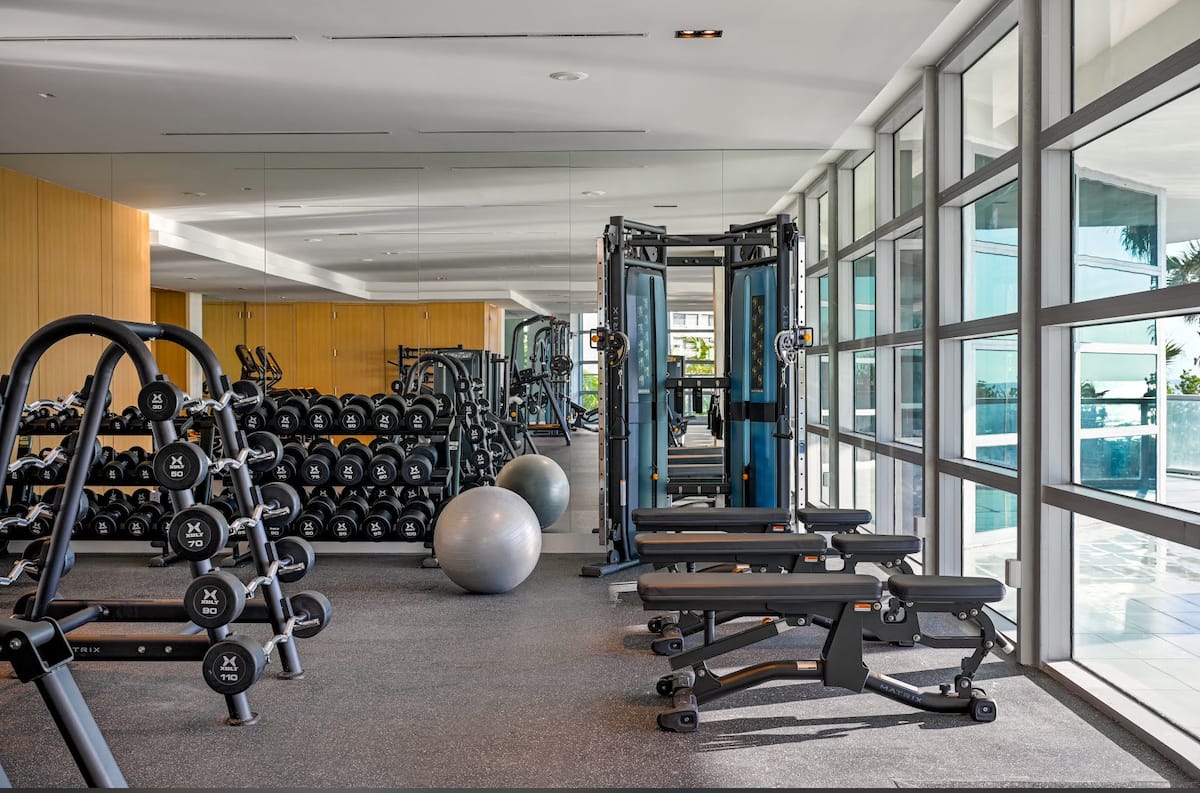
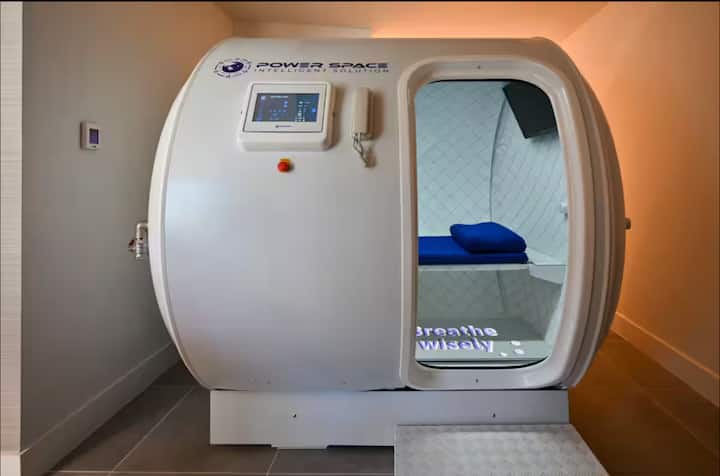
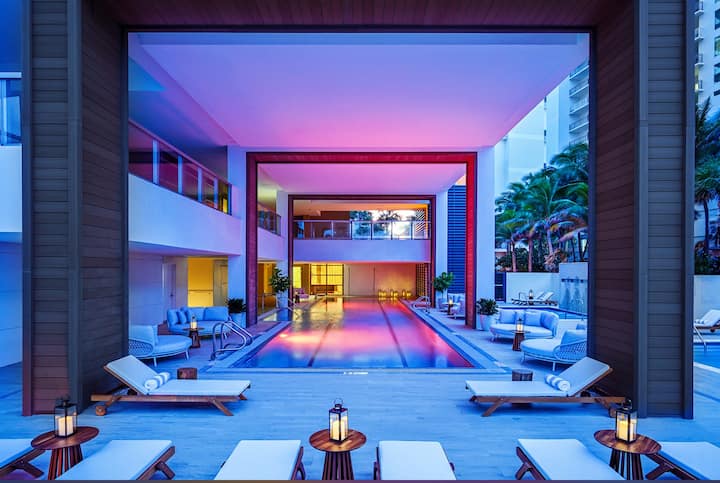
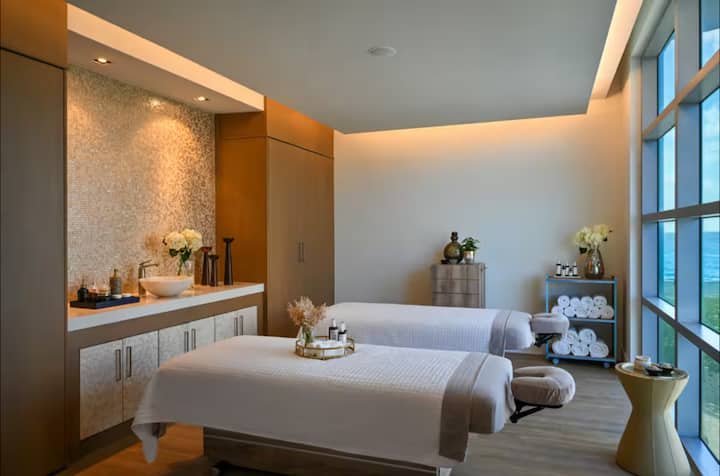
What makes red light therapy unusual here is not the panels but the address. It sits among the touchless regenerative therapies in the wellness centre a short elevator ride below OASENA — the same floors that hold the IV lounge, the hyperbaric oxygen chamber, the dry flotation and the PEMF mat, the Ammortal chamber, and the hands-on treatment rooms. The wellness centre runs to roughly 100,000 square feet with 22 treatment rooms, so red light is one deliberate station in a much larger world rather than a lone booth in a strip-mall studio.
Practically, that changes how you can use it. Because you never leave the building, a red-light session is easy to fold into a slow morning or a recovery afternoon without a car, a drive home, or a tight booking window. You can come down after a swim, spend a quiet quarter hour in front of the panel, and be back on the balcony before your coffee cools. Residence guests reach the wellness centre at preferred rates, though access follows the resort’s own terms and hours, so it is worth confirming availability and booking your session ahead, especially in the busy winter months.
How it fits with the other regenerative therapies
- Hyperbaric oxygen therapy shares the touchless, recovery-minded corner of the menu; some guests pair light with an oxygen session across a longer wellness morning. Each has its own guide, and its own honest evidence.
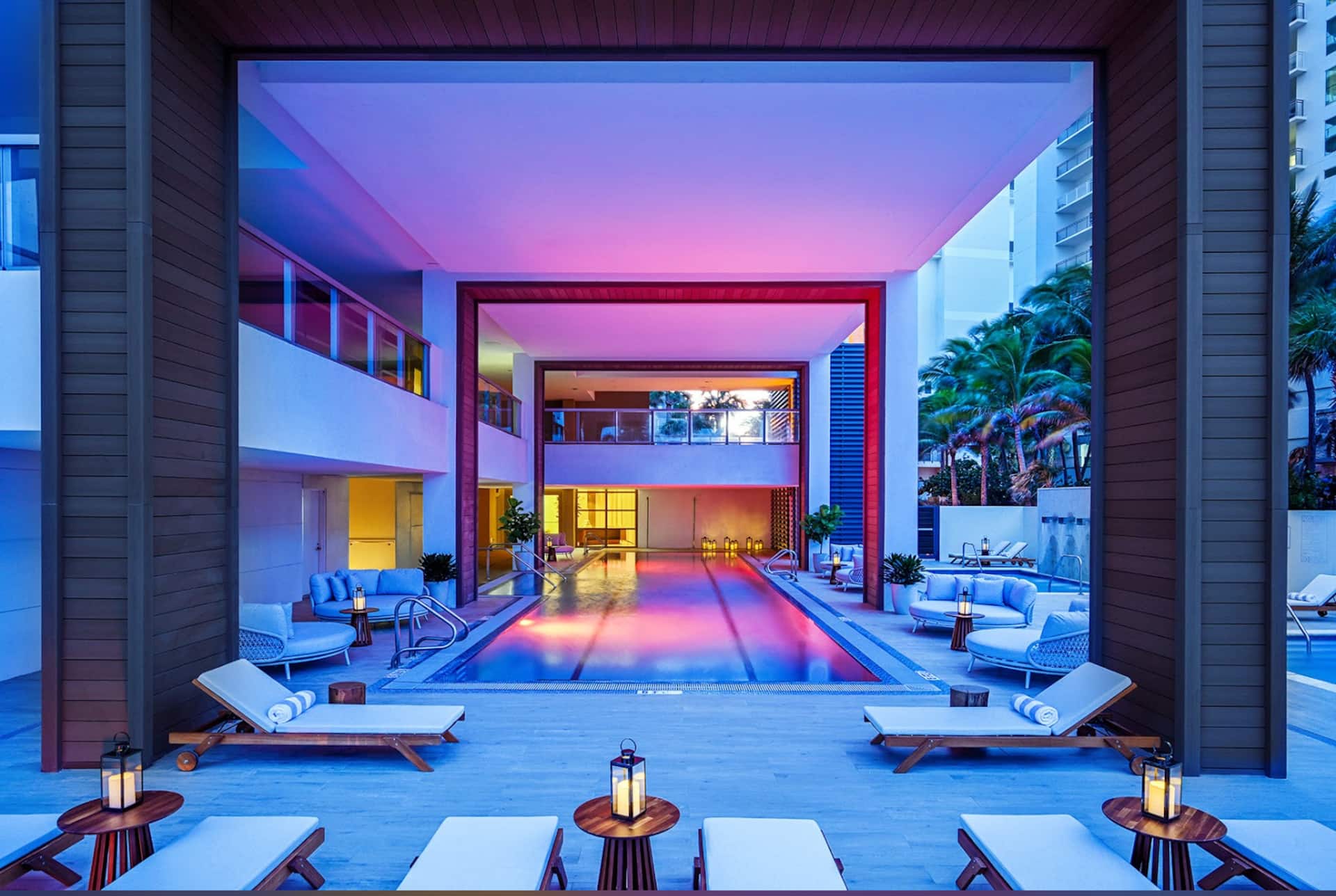
- The cold plunge and arctic chill of the Aayush hydrothermal circuit make an easy counterpoint — warm, still light after bracing cold is a pleasant sequence, and cold and light are studied for overlapping recovery reasons.
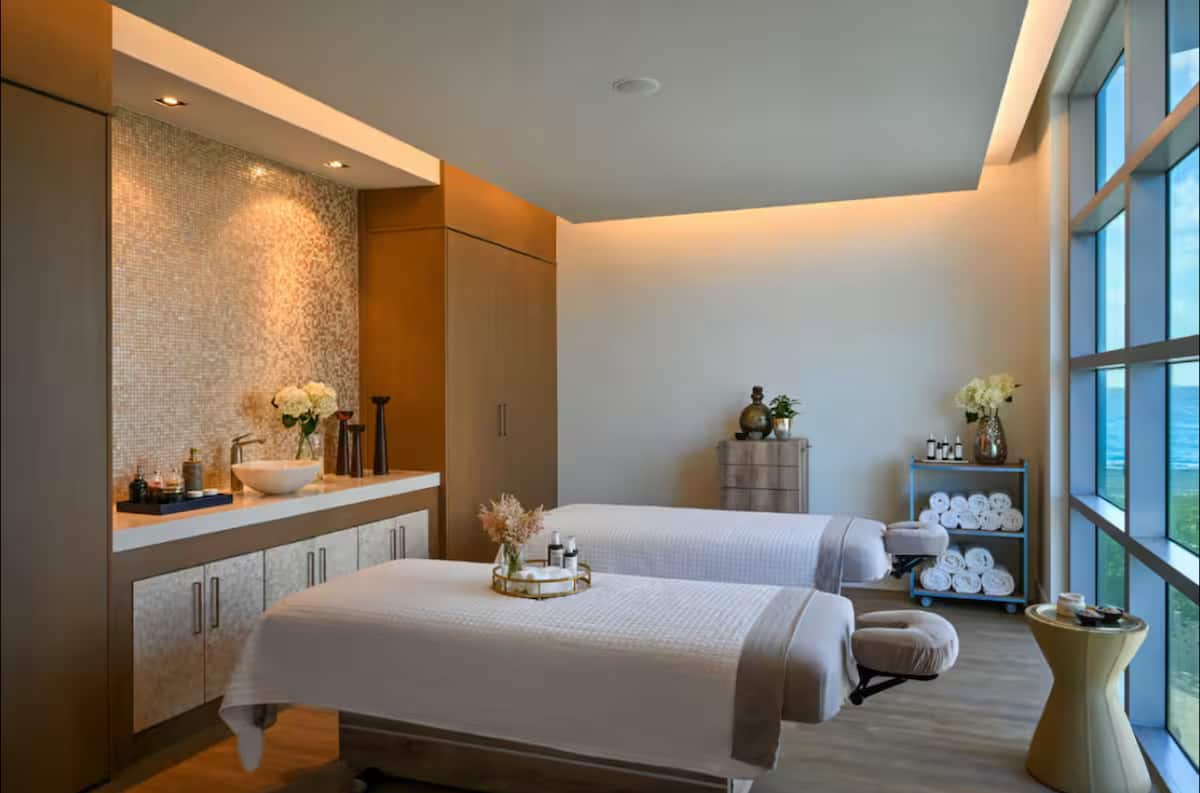
- A massage in one of the treatment rooms rounds out a recovery day; light before or after bodywork is a common, agreeable pairing.
There is also a simple, practical charm to having it on site. Many red-light studios elsewhere are a drive away, sell packages, and turn a fifteen-minute session into a half-day errand once you count the traffic. Here it is a lift ride and a few unhurried minutes, which changes how you use it: less a destination, more a habit you can dip into around everything else. That convenience is easy to underrate until you have tried to fit wellness into a trip the ordinary way. When the panel is downstairs, you use it — and using it a little, often, is exactly how the evidence suggests it works best.
A word on expectations inside a resort setting. A spa environment is designed to make everything feel restorative, which is lovely, but it can also make any single service feel more powerful than the evidence strictly supports. Keep the modest, honest framing from earlier in mind: solid for skin, reasonable for recovery, pleasant either way, and not a medical treatment. Held like that, the red-light suite is a nice use of twenty minutes and a sensible part of a wellness-minded stay — not because it promises the world, but because it does a small thing well, in a very convenient place, at a rate that makes trying it easy. The staff can point you to the right panel, set the distance and the timer, and answer questions about your particular situation.
10Folding it into a Singer Island day
The nicest version of a red-light session is not a standalone errand but a small, warm punctuation mark in a slow day. Because the suite is a few floors below where you are sleeping, it slots into a morning or an afternoon with almost no friction, and it pairs naturally with the rhythm of a beach stay. Here is one easy way to build it in.
A gentle recovery morning
- Start on the water. An early swim off the private beach, or a snorkel over the reef at Ocean Reef Park, gives your body something real to recover from and the light a job to do.
- Move down to the wellness centre. Warm up in the sauna and take a brief cold plunge in the Aayush circuit, then settle in front of the red-light panel for your quiet ten to twenty minutes while your legs are still humming from the cold.
- Finish soft. Water, a slow shower, and a plant-forward lunch at TULĀ on property, or a short walk to casual seafood at Johnny Longboats on the Municipal Beach.
- Let the afternoon be nothing. Back up to the residence, open the balcony doors, and let the Atlantic finish the job the light started.
If mornings are for the beach, the same idea works just as well as an afternoon reset. Come in from a long day on the water or a round of golf, rinse off, and take your quiet quarter hour in the light before you shower and change for dinner. The warmth is welcome after sun and salt, the pause settles you for the evening, and you arrive at a table across the bridge feeling looser than you would have otherwise. There is no wrong time of day for it, which is part of why it is so easy to keep up over a stay.
For a skin-minded routine on a longer stay, the pattern is different: shorter, more frequent visits woven through the week, face clean, expectations calm, results allowed to build quietly rather than demanded all at once. Neither approach needs to dominate your trip. The whole point of having the suite downstairs is that wellness becomes something you dip into around the real reasons you came — the beach, the boats, the reef, a good dinner across the bridge — rather than a schedule you have to serve.
A last word
Red light therapy is an interesting practice with a real scientific core, a long and slightly accidental history, and a habit of being oversold. Come to it for what it reliably offers — support for your skin, a modest hand with recovery, and a warm, restful pause with nothing to do — and it will very likely please you. Ask your doctor first if you are pregnant, take a light-sensitizing medication, or have a skin or eye concern, and never let a glowing panel stand in for real medical care. Held with that honesty, a quarter hour in the red light below the residence is a small, agreeable pleasure — and one of the easier ones to enjoy on Singer Island, since it is waiting a single elevator ride away.
Common questions
Is red light therapy safe?
For most healthy adults it is very well tolerated and painless, with no ultraviolet and no downtime. Protect your eyes from the bright panel, and ask your doctor first if you are pregnant, take a photosensitizing medication, or have a skin cancer, a suspicious spot or a photosensitive condition. It is a wellness service, not a medical treatment, and should never replace a doctor’s care.
Will I feel or see results right away?
You will feel a gentle warmth during the session and often a pleasant, relaxed calm afterward. Visible results — fresher-looking skin, or muscles that feel less heavy — tend to build gradually over several short sessions rather than appearing after one. Some people notice a clear effect and some notice very little; both are normal.
How long and how often should a session be?
Sessions usually run about ten to twenty minutes, and longer is not better — the helpful dose sits in a window, and too much can blunt the effect. On a stay of any length, a handful of relaxed sessions across the week, at the distance and timing the spa suggests, is a sensible rhythm.
Can red light therapy treat a medical condition or slow aging?
No. The evidence is reasonably good for skin and for some muscle recovery and soreness, and there is a specific medical use for certain mouth sores, but claims about fat loss, serious disease, hormones or broadly slowing aging run well ahead of the science. Use it as a pleasant complement to good habits and your doctor’s care, not as a substitute for either.
A note on wellness & health
This guide is general information about therapies offered at the resort spa, not medical advice, diagnosis or treatment. Wellness services are elective and results vary from person to person. Talk with a qualified healthcare professional before starting any new therapy, especially if you are pregnant or managing a medical condition. OASENA is privately owned and is not operated by, affiliated with, or endorsed by Amrit Ocean Resort & Residences. Spa access is offered to residence guests at preferred rates, subject to the resort’s terms and availability.

Your quiet address above the Atlantic
OASENA is a private two-bedroom home on the twelfth floor of the Happiness Tower — floor-to-ceiling ocean views, a sweeping balcony, and this entire wellness world an elevator ride below.
OASENA is a privately owned residence within Amrit Ocean Resort & Residences and is not operated by, affiliated with, or endorsed by the resort. See credits & notes.