
Sauna and Heat Therapy: Traditional and Infrared
One elevator ride below the residence, in the Aayush circuit, sit two very different hot rooms. Here is what a traditional sauna and an infrared cabin do to the body, what the long Finnish studies really show, and how to use the heat well and safely.
01What sauna and heat therapy are
A sauna is one of the simplest wellness ideas there is. You sit in a hot room, your body works to cool itself, and then you step out and rest. That is nearly all of it. A traditional sauna heats the air, usually with stones stacked over a heater, until the room sits somewhere between roughly 150 and 195°F. You sweat, your heart picks up its pace, and after a spell you move out into cooler air or cold water. An infrared sauna does something different. Instead of heating the air around you, it uses infrared panels to warm your body directly, so the cabin itself stays milder while you still sweat. Both are forms of deliberate heat exposure, and both belong to a very old human habit of using warmth to feel better.
It helps to say clearly what a sauna is and is not. It is a wellness practice with an interesting body of research behind parts of it, especially the traditional Finnish kind. It is not a medical treatment, it does not cure disease, and it is not a substitute for exercise, sleep, or the care of a doctor. What it reliably does is put a mild, controlled load on the body — a little like a brisk walk you take sitting still — and then hand you the loose-limbed calm that follows.
Traditional and infrared, in short
- Traditional (Finnish) sauna. Hot, dry-to-humid air from a stove and heated stones. You can ladle water onto the stones to raise the humidity in a burst of steam the Finns call löyly. The room is hot, and the heat comes at you through the air.
- Infrared sauna. Infrared emitters warm your skin and the tissue just beneath it while the air stays cooler, often around 110 to 140°F. People who find a full-heat sauna overwhelming often sit more comfortably in infrared, because the air they breathe is not as hot.
Heat therapy is really an umbrella term for using warmth on purpose, and the sauna is its most complete form because it warms the whole body at once. That whole-body quality is what sets it apart from a heating pad on a sore shoulder or a warm bath. When you sit in the heat, every system that manages your temperature switches on together, which is why the sauna has drawn the attention of researchers as well as tired travelers. It is also why the practice deserves a real explanation rather than a brochure — there is genuine physiology here, some solid evidence, some thin evidence, and a few safety lines worth knowing before you sit down.
This guide walks through where the sauna came from, what heat does inside the body, what the research does and does not support, how a good session goes, who should be careful, and how the saunas in the Aayush circuit below the residence fold into an easy Singer Island day. The short version, stated up front so nothing is oversold: the traditional sauna carries the stronger science and the far longer history, while infrared is pleasant and gentler but rests on thinner evidence. Both are worth understanding before you sit down in the heat, and both reward a little care in how you use them.
02A Finnish inheritance, and an older one
The sauna as we know it is Finnish to the bone. For most of a thousand years, ordinary Finnish families built a small wooden room with a stove of stones, and it was one of the most important rooms they had. In a cold country, it was where you got warm, washed, gave birth, cured meat, and sat with your neighbors. The word sauna is itself Finnish, one of the few to travel intact into nearly every language. To this day Finland, a country of about five and a half million people, is thought to have well over two million saunas — in homes, apartment buildings, offices, and beside a great many lakes.
The heat bath is older than Finland, though. Many cultures arrived at the same idea independently, because the human body responds to heat in the same way everywhere. Consider the lineage:
- The Roman thermae built vast public bathing complexes with hot rooms, warm rooms, and cold plunges — a contrast circuit that would look familiar to anyone who has walked the Aayush stations in order.
- The Turkish hammam carried the steam-and-scrub tradition through the Ottoman world, and survives at Amrit in its own Moroccan hammam ritual.
- The Russian banya is a close cousin of the Finnish sauna, humid and hot, often finished with a birch-branch whisk and a cold dunk.
- Indigenous sweat lodges across North America used heated stones and steam in ceremony long before Europeans arrived, a reminder that this is a very old and very widespread instinct.
The Finnish sauna was never really about health claims. It was about warmth, cleanliness, and company in a hard climate, and the etiquette grew up around those simple needs: you keep your voice down, you respect the heat, and you do not hurry. Families passed the practice down without ever writing a rulebook, and to this day a Finn will tell you the sauna is a place to be honest and quiet rather than to perform. That unhurried spirit is worth carrying into any modern spa, because it is the part no machine can supply. The löyly — the burst of steam off the stones — is treated almost with reverence, added a ladle at a time so the room breathes rather than roasts. A sauna rushed is a sauna wasted, and the Finns have known it for a very long time.
Infrared heat is the newcomer by centuries. The idea of warming the body with radiant heat rather than hot air grew out of twentieth-century work on infrared lamps, and cabins built around infrared emitters only became a common spa fixture in recent decades. In Japan, a form of far-infrared heat treatment known as Waon therapy was developed and studied in a medical setting, which is part of why infrared carries a faint clinical air the traditional sauna never needed. When you sit in a modern sauna, then, you are sitting at the meeting point of two stories: a folk tradition thousands of years deep, and a much younger technology still finding out what it can honestly claim.
03How heat changes the body
Step into a hot room and your body treats it as a challenge to manage, which is the whole point. Your core temperature begins to climb, usually by around one to two degrees over a session. Your skin warms toward the temperature of the room. To shed that heat, the small blood vessels near the skin widen and blood is pushed toward the surface, and your heart speeds up to move it. Heart rates of 100 to 150 beats a minute are common in a hot sauna — a load on the cardiovascular system that researchers compare to light or moderate exercise, reached while you sit perfectly still.
Then you sweat. A single sauna sitting can draw off a good half-pint of fluid or more, which is exactly why hydration matters so much and why the scale reads lower afterward — that is water, not fat. Alongside all this, the body switches on a set of repair and stress-response systems that are the most interesting part of the picture.
What the heat switches on
- Heat shock proteins. Heat stress prompts cells to make these molecules, which help other proteins fold correctly and clear out damaged ones. They are one of the leading explanations for why regular heat exposure might do more than feel good.
- Cardiovascular conditioning. The rise in heart rate and the widening of blood vessels place a repeated, gentle demand on the heart and circulation — the kind of demand that, over time, the body tends to adapt to.
- Blood-pressure response. During the heat itself, dilated vessels usually let blood pressure fall a little; the swing reverses when you cool down and the vessels tighten again.
- Feel-good chemistry. Heat exposure nudges the release of endorphins and related compounds, part of why a sauna can leave you calm and a touch euphoric.
- A mild immune stir. The body treats a sauna a little like a brief, harmless fever, and some researchers suspect this small stress is part of why regular users report fewer everyday sniffles — though this, like much here, is more suggestive than settled.
The cool-down is not an afterthought — it is half the mechanism. When you step out into cooler air or a cold plunge, the surface vessels clamp down, blood is redirected, and you feel that sharp, clean rebound. Cycling between hot and cold is the tradition for a reason, and it is built into the Aayush circuit, where a sauna sits within reach of cold plunge pools and arctic chill fountains. Infrared works along the same lines but arrives more gently: because the air stays cooler, the heart-rate and core-temperature changes tend to be milder for a given amount of time in the cabin, which is a fair part of its appeal and, honestly, part of why its effects are harder to measure.
One more thing is worth knowing: the body adapts. Sit in the heat regularly and you become a more efficient sweater, starting to sweat sooner and cooling yourself better, much the way a body adapts to regular exercise. This is part of why lifelong sauna cultures build a heat tolerance that can startle a first-timer, and why you should never try to match a seasoned bather round for round on your first visit. Start low, start short, and let your own tolerance grow at its own pace over days rather than minutes. The adaptation is real, but it is earned gradually, and there is nothing to gain from forcing it.
04Traditional heat and infrared: two different rooms
People often ask which is better, and the short answer is that they are not really the same thing wearing two labels. They heat you by different means, feel different to sit in, and stand on very different amounts of evidence. It is worth understanding both before you decide which room to reach for on a given day.
How they differ
- The heat source. A traditional sauna heats the air, and the hot air heats you. An infrared cabin sends radiant energy that warms your body directly while the surrounding air stays cooler.
- The temperature. Traditional saunas run hot, commonly 150 to 195°F. Infrared cabins usually sit far lower, often 110 to 140°F, because they do not rely on the air to carry the heat.
- The breath. In a hot sauna the air itself is hot to inhale, which some people love and others find hard. In infrared the air is milder, which is why people who dislike the intensity of a Finnish sauna often prefer it.
- Humidity. A traditional sauna can be dry or, with water on the stones, briefly steamy. Infrared cabins are dry by nature.
- The sweat. Both make you sweat. In infrared you tend to sweat at a lower air temperature, which some people find more comfortable to stay in longer.
- The feel afterward. Many people describe the traditional sauna as more of a jolt and infrared as more of a slow melt. Which you prefer is largely personal, and worth trying both to learn.
The claim you will hear most often for infrared is that its radiant heat penetrates more deeply than hot air and so produces a different, more thorough sweat. That idea is popular in marketing and physically plausible in a limited way, but it is not well established in good research, and you should treat confident promises about deep detoxification or fat-burning with real skepticism. Your body detoxifies mainly through the liver and kidneys, not the sweat glands, and no sauna changes that. Sweat is mostly water and salt, with only trace amounts of anything else.
There is also a plain practical difference in how the two feel over time. A traditional sauna delivers its heat fast and hard, so sessions are short and vivid; you know you have been somewhere. An infrared cabin builds more slowly, so people tend to sit longer and read the experience as calmer and more meditative. Neither is more virtuous than the other. If anything, the risk with infrared is that its very mildness tempts people to stay in far too long chasing a heavier sweat, which is its own way to overdo it. The clock still matters, even when the room feels gentle.
So how to choose? If you want the tradition, the intensity, and the practice with the strongest science behind it, the traditional sauna is the one. If you find high heat unpleasant, if the hot air bothers your breathing, or if you simply want a milder, quieter session, infrared is a reasonable and comfortable alternative — just hold its bolder health claims loosely. Many people at Amrit end up using both, matching the room to the day and to how their body feels, and there is no wrong answer in that.
A sauna asks your body to work the way a brisk walk does, then hands you the deep calm that comes after — which is why people have kept building them for two thousand years.
On the sauna in the Aayush circuit
05What the evidence does and doesn't say
This is the section worth reading slowly, because the sauna is one of the few spa practices with real long-term research attached — and because that research is easy to overstate. The strongest data comes from Finland, where scientists have followed large groups of middle-aged men for decades and tracked how often they used the sauna against how their health turned out.
The headline findings are striking. In this Finnish work, men who used a traditional sauna four to seven times a week had markedly lower rates of death from cardiovascular causes, and lower all-cause mortality, than men who went only once a week — a difference on the order of about half in the heaviest users. Later analyses from the same body of research reported associations with lower risk of stroke, of high blood pressure developing, and even of dementia. Taken at face value, those are remarkable numbers.
Why to hold them carefully
- This is observational research, not proof of cause. The studies watched what people already did; they did not assign saunas at random. That is a crucial distinction. It shows a strong association, not that the sauna itself caused the better outcomes.
- Healthier people may simply sauna more. Someone well enough to sit in a hot room several times a week may already be healthier, more relaxed, and better off in ways the numbers cannot fully separate out.
- The setting is Finnish and mostly male. The findings come from a particular culture with a particular sauna habit, and much of the landmark data is in men, so how neatly it transfers is an open question.
What makes the sauna more than wishful thinking is that the association is strong, it follows a dose-response pattern — more sessions, more benefit — and there is a believable mechanism, in that a sauna loads the heart somewhat like exercise. Those three things together are why serious researchers take it seriously. But association plus plausibility is not the same as proof, and no honest guide will tell you a sauna will add years to your life.
How should a sensible person hold all this? Somewhere between dismissal and enthusiasm. It would be wrong to wave the Finnish findings away, because they are large, consistent, and biologically plausible, and they point in the same direction across more than one measure. It would be just as wrong to treat a sauna as a proven medical intervention, because the studies simply cannot carry that weight. The honest reading is that regular sauna use is very likely good for you, or at the least harmless when done safely, and that this is a reasonable thing to enjoy without expecting it to work miracles or replace the basics of sleep, movement, and diet.
For everyday claims the ground is firmer but more modest. Saunas are well supported as a way to relax, unwind, and ease general muscle soreness, and many people sleep better after one. For athletic recovery the evidence is mixed and the effects are small. And infrared specifically sits on much thinner ice: its studies are fewer, smaller, shorter, and sometimes tied to the companies selling the cabins. The Japanese Waon work on heart patients is interesting, but it was done in a supervised clinical setting and does not license broad wellness promises. The fair summary: the traditional sauna is a pleasant practice with intriguing long-term associations you should not treat as promises, and infrared is a comfortable heat experience whose bigger health claims outrun the data.
06What a session is like
A sauna asks almost nothing of you, which is part of the pleasure. You arrive, you sit, and you let the heat do the work. Still, a few small habits make the difference between a session that leaves you glowing and one that leaves you lightheaded, so it is worth knowing how a good one goes before you settle in.
You go in with clean skin and, in most spa settings, a swimsuit and a towel to sit on. Leave your phone outside — the heat is hard on electronics and the point is to switch off anyway. Sit on the lower benches first if you are new to it, since heat rises and the top bench is considerably hotter than the one below. Breathe slowly. In a traditional sauna you may feel the urge to add a ladle of water to the stones for a wave of steam; a little goes a long way, and it is polite to ask the room before you do.
A simple rhythm
- First round. Ten to fifteen minutes, or less if the heat feels like plenty. There is no prize for suffering.
- Cool down. Step out, cool off in cooler air, a cool shower, or a cold plunge, and let your heart settle for a few minutes.
- Rest and rehydrate. Drink water, sit down, let your body come back to baseline.
- Repeat if you like. Two or three rounds is a common pattern for regulars, but one unhurried round is completely fine.
If it is your first time, some of what you feel may surprise you. The first few minutes can feel like a lot before your body finds its rhythm and begins to sweat; that is normal, and it usually eases into comfort. Your heart will be beating faster than it does at rest, which is expected rather than a cause for alarm. What you are after is the tipping point where effort turns into ease — the moment the heat stops feeling like a challenge and starts feeling like a release. Most people reach it well inside ten minutes, and there is no reason at all to push past it in search of some tougher milestone.
Listen to your body over any clock on the wall. The signals to leave the heat are clear: dizziness, a pounding or fluttering heart, nausea, headache, or that prickly, unwell feeling that is different from pleasant warmth. If any of those show up, step out, cool down, and drink water. Sauna sessions in the Aayush circuit run in the range of about fifteen to twenty minutes at a stretch, which is a sensible ceiling for most people. Infrared cabins, being cooler, are often used a little longer, but the same rule holds — comfort first, always.
Afterward, expect to feel warm, loose, and pleasantly tired, sometimes for hours. Give yourself somewhere soft to land next rather than rushing straight back into the day: a relaxation lounge, a quiet chair, the terrace with the ocean in front of you. Keep drinking water. And save the sauna for when you have the time to do it slowly, because the calm at the end is most of what you came for.
07What people feel, and what to expect
Set aside the long-term research for a moment and ask a simpler question: what does a sauna do for you this afternoon? Here the answers are humbler and, in their way, more reliable, because they rest on how people consistently say they feel rather than on decades of tracking. Most of what draws people back to the heat is immediate.
What regulars tend to describe
- Deep relaxation. The most common report by far. The heat, the quiet, and the absence of anything to do combine into a state that is hard to reach any other way. For many people this alone is the whole reason.
- Better sleep. A good number of people sleep more soundly on a sauna evening. The likely reason is the cooldown afterward: as your warmed body sheds heat, the drop in core temperature is a cue the body reads as time to rest.
- Looser, less achy muscles. Heat increases blood flow to muscles and simply feels good on tired legs and a stiff back. The effect on hard athletic recovery is modest in studies, but the comfort is real.
- A lift in mood. Between the endorphin response and the pause from everything else, people often step out lighter than they went in.
- Skin that feels clean. A good sweat and rinse leaves the skin feeling fresh, though this is about how you feel rather than any deep chemical cleanse.
- A sense of ritual. Done regularly, a sauna becomes a small anchor in the day or the week — a reliable place to reset. That structure is quietly valuable on its own.
It is worth noticing how many of these benefits are really the same benefit wearing different clothes. The relaxation, the better sleep, the lift in mood, the sense of ritual — all of them flow from the same source, which is twenty uninterrupted minutes in which there is nothing to do and nowhere to be. Modern days offer very few of those. The heat enforces the pause in a way a good intention rarely can: you cannot check a phone in a sauna, you cannot really hold much of a conversation, and you certainly cannot work. That enforced stillness may be the most underrated thing a sauna gives you, and it costs nothing but the willingness to sit down and let it.
Two honest caveats keep this list grounded. First, a sauna is not exercise. It raises your heart rate and it feels like effort, but it does not build fitness or burn meaningful fat, and any weight you lose during a session is water you should drink straight back. Second, benefits like these are best understood as things that support how you feel, not treatments for any condition. If you live with a health problem, treat the sauna as a pleasant addition to good medical care, never a replacement for it. Within those limits, the case for the sauna is easy to make: it is a low-effort, low-cost way to feel calmer, sleep a little better, and take twenty quiet minutes for yourself, which is more than most wellness practices can honestly promise.
08Who it suits, and who should ask a doctor first
For most healthy adults, a sauna used sensibly is safe and welcome. It suits travelers carrying the stiffness of a long flight, anyone winding down after a day on the water, and people who simply want a warm, unhurried pause. But heat is a real load on the body, and there are people and situations that call for genuine caution or a conversation with a doctor before you go in.
Ask a clinician first if
- You are pregnant. Raising core body temperature carries risks in pregnancy, particularly early on, and the standard advice is to avoid hot saunas or clear it with your doctor or midwife first. If you go at all, keep it short, cool, and cautious.
- You have a heart condition. Unstable angina, a recent heart attack, significant valve disease such as aortic stenosis, or poorly controlled heart rhythm problems all deserve medical advice before sauna use, since the heat asks the heart to work harder.
- Your blood pressure is very high or very low, or unstable. The heat lowers blood pressure during a session and swings it back on cooldown; if yours is hard to control, get guidance first.
- You take medications that affect heat, hydration, or blood pressure. Some drugs blunt sweating or the body’s ability to regulate temperature. Your doctor or pharmacist can tell you if yours are among them.
Simple rules that keep it safe
- Never mix a sauna with alcohol. This is the most important line in this guide. Alcohol dehydrates you, interferes with temperature regulation, and strains the heart, and the combination has caused real harm. Skip it before and during.
- Hydrate. Drink water before and after. Go in already dehydrated and you are asking for trouble.
- Do not go in unwell. Fever, an active infection, or feeling run-down are all reasons to wait.
- Do not go alone if you are unsure. If you have any doubt about how your body will handle heat, have someone nearby.
- Ease children and older adults in gently. Both regulate temperature less efficiently; keep sessions short and supervised, and follow the resort’s policies.
A word specifically about dehydration, because it is the quiet cause behind most sauna mishaps. You lose a real amount of fluid to sweat, and if you started the day already short — a long flight, a few drinks the night before, a morning of coffee and no water — the heat can tip you from merely tired into unwell. The fix is boring and effective: drink water before you go in, keep some within reach, and drink more after. If your heart races or your head goes light, that is your body asking for fluid and cooler air, and the right response is to give it both without hesitation rather than waiting to see if it passes.
None of this is meant to frighten you off. The great majority of people can enjoy a sauna with nothing more than common sense: keep it short, stay hydrated, skip the alcohol, and step out the moment you feel off. But heat therapy is a real physiological event, not just a warm room, and treating it with a little respect is exactly what lets you enjoy it for years.
09The saunas in the Aayush circuit
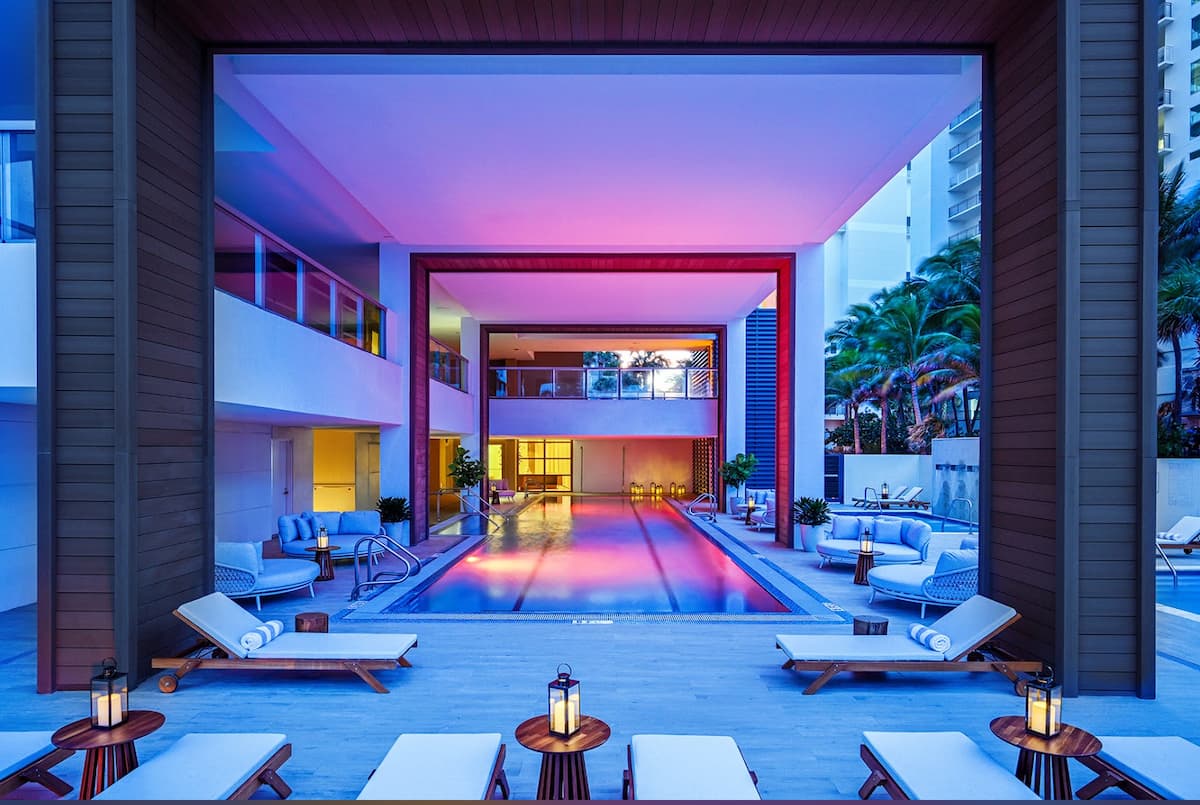
What makes the sauna here easy to use is its address. It sits within the Aayush Hydrothermal Experience, the self-guided circuit that fills part of the roughly 100,000-square-foot wellness centre a short elevator ride below OASENA. You do not book a sauna the way you book a massage. You come down, change, and move through the stations at your own pace, and the sauna is one stop among several designed to flow into one another.
The circuit is built around the old logic of contrast: warm the body, cool it sharply, rest, and repeat. Laid out around the sauna are the pieces that make that possible:
- Hot and cold plunge pools for the classic heat-then-cold swing.
- Arctic chill fountains for a bracing cool-down between rounds.
- An effusion shower to rinse and reset.
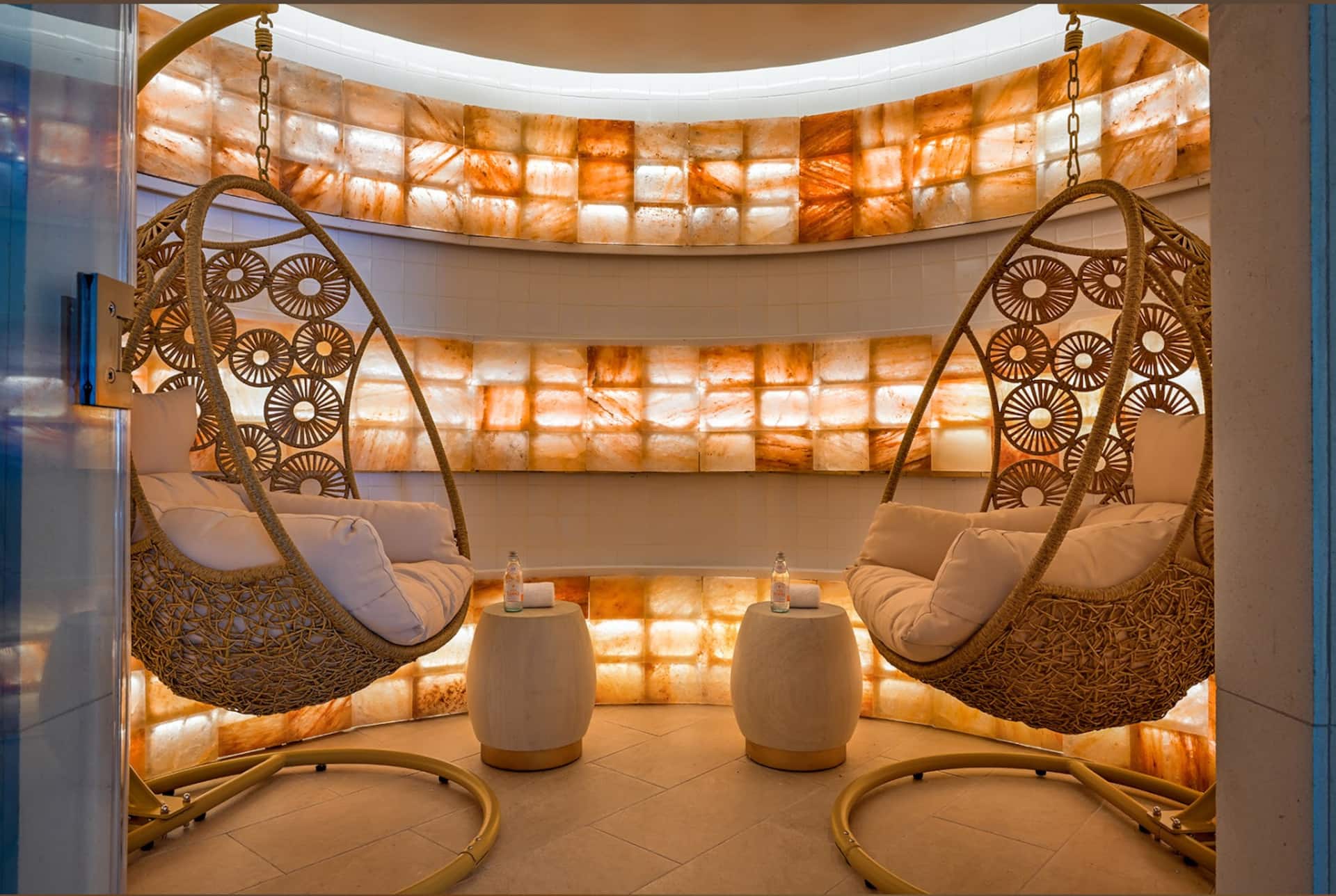
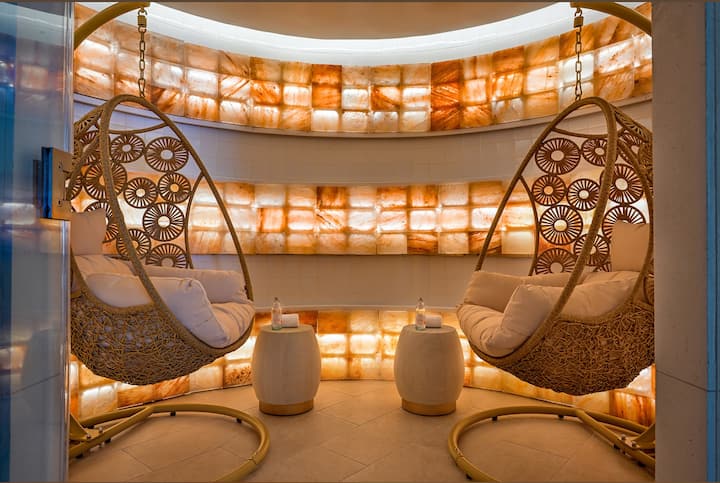
- A salt inhalation chamber and a hydro-reflexology aquatic path for the gentler, restful stretches of the circuit.
Because it is self-guided, there is no single correct route, but a natural one is to warm up in the sauna, cool off in a plunge or under the arctic chill, rest, and drift on to the salt room or the reflexology path before circling back. The resort suggests giving the whole experience about ninety minutes to two hours, which is time enough to move slowly and never feel hurried. That unhurried pace is the point; the circuit is designed to be lingered in, not rushed through.
The sauna also sits within a much larger wellness world, and it helps to picture where it fits. The centre runs to some 100,000 square feet with 22 treatment rooms, so the hydrothermal circuit is only one wing of what waits downstairs; beyond it are massage rooms, advanced facials, a Moroccan hammam ritual, and a suite of regenerative therapies. Many guests treat the Aayush circuit as the relaxed, self-guided half of a wellness day and book a massage or a facial around it, using the sauna and plunges to warm up beforehand or to unwind after. Because the circuit asks for no appointment and no set start time, it is the easy part to fold in on a whim, whether you have two free hours or twenty spare minutes.
A few practical notes for guests of the residence. Access to the wellness centre comes at preferred rates for residence guests, and the circuit is subject to the resort’s terms and hours, so it is worth confirming details when you arrive. Bring a swimsuit; towels and the rest are part of the spa. It is a shared space, so the usual quiet-voice, respect-the-room etiquette applies, and it pays to check the day’s hours, since the circuit and the wider centre keep their own schedule. And remember that the residence is privately owned and is not operated by or affiliated with the resort — the wellness centre is a neighbor you can reach without stepping outside, which is a rare and useful thing. The short version: the sauna below OASENA is not a stand-alone appointment but one warm station on a longer, quieter journey, and it is best used as part of that whole rather than on its own.
10Hot, then cold, and a Singer Island day
The oldest way to use a sauna is also the best, and it is the one the Aayush circuit is built for: heat, then cold, then rest. Finns have plunged from the sauna into an icy lake — a hole in the ice they call an avanto — for as long as they have had saunas, and the Russians, the Nordics, and half the bathing cultures of the world arrived at the same instinct. There is a reason it feels so good. The heat opens you up and the cold snaps you back, and the swing between them leaves a clean, alert calm that neither one gives you alone.
How to pair heat and cold well
- Heat first. Ten to fifteen minutes in the sauna, until you are thoroughly warm but still comfortable.
- Then cold, briefly. A short dip in the cold plunge or a pass under the arctic chill — a minute or two is plenty, and even less is fine at first.
- Then rest. Sit, breathe, let your heart settle and your body find its balance before you decide whether to go again.
- Know the cold’s cautions. The cold plunge carries its own contraindications, especially for heart conditions; if that is you, be conservative or skip the cold and simply cool in the air. Never make either the heat or the cold a test of endurance.
Do not feel you must brave the cold plunge to do this properly. Plenty of people get most of the benefit simply by stepping out into cooler air and letting the sweat lift, no plunge required, and there is no shame in easing into the cold over several visits rather than all at once. The contrast is a pleasure to grow into, not a rite of passage to endure. Start with what feels good, add a little more cold as your body asks for it, and end the round the moment either the heat or the cold stops being enjoyable.
Folded into a Singer Island day, the circuit works best in the morning, before the beach heat peaks. Come down after coffee, move through the hot and cold stations slowly, finish on a lounger with water, and then go back up, open the balcony doors, and let the day begin properly — the beach with its butler and chair service, an easy lunch at Johnny Longboats or out at the Sailfish Marina, an afternoon in the water. On a cooler winter evening you might flip it and use the sauna at the end of the day, to unwind before dinner across the bridge on Clematis Street or Worth Avenue.
However you place it, keep the spirit of the thing in mind. A sauna is not a task to complete or a metric to chase. It is a warm room with a very long history, a mild and honest stress that your body knows how to answer, and a quiet reward at the end. Use it slowly, respect the heat, drink your water, and let the Atlantic finish the job when you come back up.
Common questions
Is a sauna safe for me?
For most healthy adults, yes, used sensibly — keep sessions to about fifteen to twenty minutes, stay hydrated, and never combine a sauna with alcohol. Ask your doctor first if you are pregnant, have a heart condition, or have blood pressure that is hard to control, and step out at once if you feel dizzy, nauseous, or lightheaded.
Which is better, a traditional sauna or infrared?
They are different experiences. The traditional Finnish sauna is hotter and has the stronger research behind it. Infrared cabins keep the air cooler and feel gentler, which many people prefer, but their bigger health claims rest on much thinner evidence. If high heat bothers you, infrared is a comfortable choice; if you want the tradition and the science, go traditional.
Do the sauna's health benefits mean it will make me live longer?
No, and it is worth being clear about that. The well-known Finnish studies found that frequent sauna users had lower rates of heart disease and death, but that research is observational — it shows a strong association, not proof that the sauna itself is the cause. Treat the sauna as a relaxing practice with intriguing links to good health, not a promise of it.
Should I use the cold plunge after the sauna?
That hot-then-cold contrast is the classic way to use the Aayush circuit and most people find it invigorating. Keep the cold dip short, rest between rounds, and be cautious — the cold plunge has its own contraindications, especially for heart conditions. If you are unsure, simply cool down in the air instead of the cold water.
A note on wellness & health
This guide is general information about therapies offered at the resort spa, not medical advice, diagnosis or treatment. Wellness services are elective and results vary from person to person. Talk with a qualified healthcare professional before starting any new therapy, especially if you are pregnant or managing a medical condition. OASENA is privately owned and is not operated by, affiliated with, or endorsed by Amrit Ocean Resort & Residences. Spa access is offered to residence guests at preferred rates, subject to the resort’s terms and availability.


Your quiet address above the Atlantic
OASENA is a private two-bedroom home on the twelfth floor of the Happiness Tower — floor-to-ceiling ocean views, a sweeping balcony, and this entire wellness world an elevator ride below.
OASENA is a privately owned residence within Amrit Ocean Resort & Residences and is not operated by, affiliated with, or endorsed by the resort. See credits & notes.